Book 8 to 10 Weeks, Check Venue Access for UK Group Tour Transport
Prevent day-of access problems and delays with this UK checklist: set headcount buffers, confirm venue access, and compare vetted coaches on Movable.
Book 8 to 10 Weeks, Check Venue Access for UK Group Tour Transport
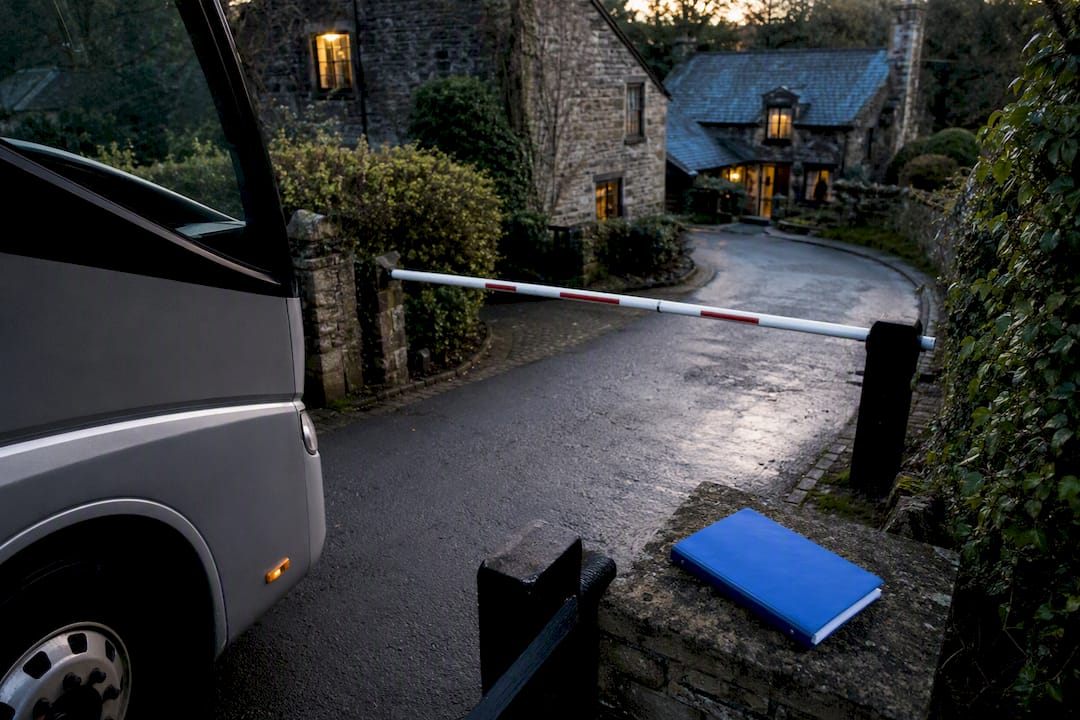
The reliable way to plan group transport is to fix the trip brief first, then match the vehicle, confirm venue access in writing, book early, and communicate clearly with passengers on the day. Follow that order and most transport failures never happen. Marketplaces such as Movable exist precisely to make this sequence easier, connecting organisers with vetted UK coach and bus operators rather than leaving you to chase quotes cold. The rest of this guide walks through each step in the order that actually prevents problems.
TL;DR:
- Booking at least 8 to 10 weeks in advance is essential for groups of 30 or more to secure availability and avoid last-minute issues.
- Selecting the smallest suitable vehicle based on accurate headcount, luggage, and accessibility needs keeps costs down and prevents empty seats.
- Building comprehensive buffers into timing—especially for boarding, stops, and traffic—reduces delays and scheduling stress during the trip.
- Confirming venue access, load/unload points, and parking arrangements in writing prevents costly last-minute surprises.
- Using a vetted marketplace like Movable simplifies comparisons, secures reliable operators, and streamlines coordination for complex or high-pressure bookings.
Table of Contents
- How do you start group tour transport planning?
- How do you choose the right vehicle for a group tour?
- How much time should you build into the itinerary?
- What should a group transport quote include?
- What venue checks prevent day-of transport problems?
- How do you manage passengers and communication on the day?
- How does a marketplace like Movable simplify booking?
- What happens if the coach breaks down or is delayed?
- How do you fit transport around accommodation and activities?
- What are the sustainable transport options for group tours?
- Common mistakes in group transport planning
- Book vetted UK coach and bus operators through Movable
- Sources
- FAQ
How do you start group tour transport planning?
Every transport failure traces back to a brief that was too vague. Before you request a single quote, write down the facts a coach operator actually needs to price and staff the job properly.
Start with numbers, not guesses. A practical planning brief begins with the movement of people across time and location, meaning pickup windows, addresses, contact names, and whether times are fixed or flexible all need defining before you ask anyone for a price.
- Confirm headcount and build in a buffer. Use your expected ridership plus 5 to 10 percent, since school trips, weddings, and corporate events all see late additions.
- Record exact pickup and drop-off addresses. Postcodes alone aren’t enough for coach access. Note the actual entrance, plus a named contact and mobile number for each stop.
- List every stop, timing, and special requirement. Luggage volume, sports or musical equipment, wheelchair users, and anyone needing extra boarding time all belong on this list.
- Book with realistic lead time. Groups of 30 or more should plan 8 to 10 weeks ahead, while smaller groups can often manage 3 to 4 weeks, though availability tightens fast during summer weddings, exam-season school trips, and the Christmas party run.
Get this brief right and every later step, from vehicle choice to quote comparison, becomes far simpler.
How do you choose the right vehicle for a group tour?
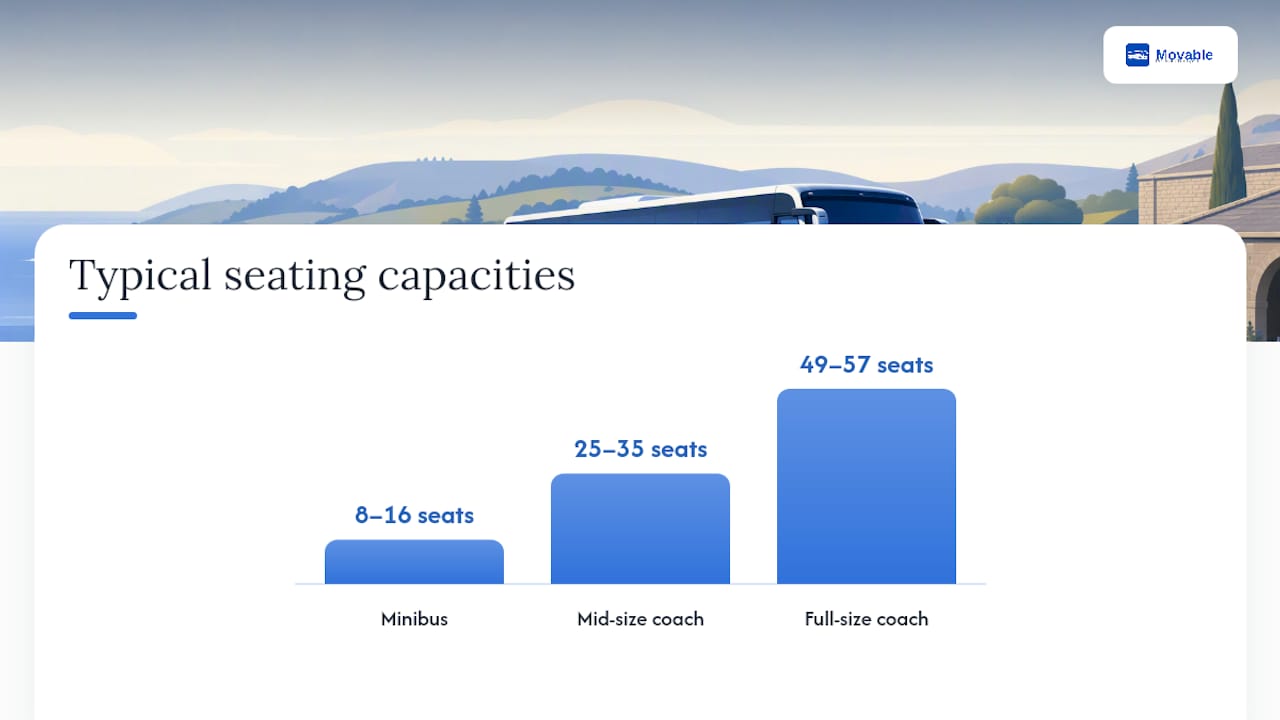
Vehicle choice comes down to one rule: pick the smallest vehicle that comfortably does the job, not the biggest one available. A 16-seat minibus suits a school sports fixture; a 70-seat coach suits a conference transfer from a hotel to a venue. Matching vehicle to ridership and trip modifiers like luggage, journey length, and accessibility needs keeps costs down and avoids paying for empty seats.
- Minibus (8 to 16 seats): local transfers, small school groups, short corporate shuttles.
- Mid-size coach (25 to 35 seats): day trips, medium wedding parties, regional tours.
- Full-size coach (49 to 57 seats): long-distance tours, large school outings, festival transport.
- Executive vehicle: VIP corporate travel, boardroom-style seating, Wi-Fi and refreshments for client-facing journeys.
For anything over two hours, check the luggage bay capacity and whether the vehicle has a toilet, since neither is standard on smaller minibuses. If anyone needs a wheelchair-accessible vehicle, book it early. Accessible vehicles are a smaller pool and lead times for confirming ramps, tie-downs, or extra boarding time run longer than standard bookings.
Pro Tip: Send the venue’s postcode and photos of the drop-off area to your shortlisted operators before booking. A coach that fits on paper can still fail to turn on a tight residential street or under a low car park barrier.
How much time should you build into the itinerary?
Timing mistakes cause more group tour headaches than mechanical breakdowns. The fix is building buffers into the schedule rather than hoping traffic behaves.
Boarding time scales with group size: a 16-seat minibus loads in a few minutes, but a full 57-seat coach with luggage can take 15 to 20 minutes to board properly, especially with older passengers or children.
- Boarding and reboarding: allow 10 to 20 minutes depending on vehicle size and passenger mobility.
- Stop allowances: budget 15 minutes per stop as a baseline, more if there’s a toilet queue or a gift shop involved.
- Traffic buffers: add 20 to 30 minutes for any journey crossing a major UK city at peak times.
- One daily buffer block: on multi-stop days, add a single 30 to 45-minute contingency block rather than padding every leg, since padding every leg compounds into a schedule nobody trusts.
Drivers also work under statutory hours and rest rules, so long transfers may need a relief driver or an overnight break built into the plan. For time-sensitive arrivals, weddings, theatre performances, conference keynotes, work backwards from the fixed start time and add at least one extra buffer beyond your normal estimate.
What should a group transport quote include?
A vague quote is the first sign of a vague operator. Detailed quote breakdowns should list base rate, mileage, fuel surcharge, driver overtime, driver accommodation for multi-day trips, tolls, and parking, and you should compare at least three providers on the same basis.
- Base rate and mileage: the core hire cost, usually tied to hours and distance.
- Fuel surcharge: some operators bake this in, others add it separately, so ask directly.
- Driver overtime and accommodation: relevant for early starts, late finishes, or multi-day tours.
- Tolls, congestion charges, and parking: small individually, but they add up on London or city-centre routes.
- Cost per passenger: divide the total quote by confirmed headcount, not your optimistic estimate, and decide upfront how no-shows are handled financially.
Ask each supplier what happens if numbers drop, what the cancellation and deposit terms are, and whether the quoted price is fixed or subject to change closer to the date. An operator unwilling to itemise costs is usually one with something to hide in the final invoice.
What venue checks prevent day-of transport problems?
Most access failures are entirely avoidable, they just get discovered on the day instead of weeks before. Local experts and destination support exist because venue staging and loading restrictions vary wildly, and confirming them by phone or map is not the same as confirming them in writing.
- Request written confirmation of loading and unloading points, including any permitted idling time, since some venues restrict engines running near entrances.
- Check physical constraints directly with the venue. Height clearance, turning radius, and overnight parking availability all need confirming rather than assumed from satellite images.
- Name a venue contact and get parking permits or access arrangements confirmed in writing ahead of the day.
- Coordinate staggered boarding with hotels or attractions if multiple groups are moving through the same pickup point, so coaches aren’t queuing behind each other.
Verifying turning radius and height clearance in writing rather than relying on a generic map is the single check organisers skip most often, and the one that causes the most last-minute scrambling.
How do you manage passengers and communication on the day?
Passengers need three messages, not one: a booking confirmation with pickup details, a reminder 24 to 48 hours before departure with the exact meeting point, and a same-day message confirming the vehicle has arrived or flagging any delay.
- Booking confirmation: pickup time, location, vehicle type, and what to bring.
- Reminder message: sent the day before, repeating the meeting point and a contact number.
- Day-of update: confirms the vehicle is on site, or explains a delay and revised timing.
- Missed-vehicle policy: state clearly in advance whether latecomers should wait for a return loop, call a nominated contact, or arrange their own way to the next stop.
Naming a single on-site transport lead removes most day-of confusion, since one coordinated point of contact keeps drivers, venue staff, and passengers working from the same information rather than three different versions of the plan.
Pro Tip: Arrive at the pickup point 15 minutes before the driver does. It gives you time to check the manifest, brief the driver on the day’s stops, and spot a missing passenger before the coach is due to leave.
How does a marketplace like Movable simplify booking?
Contacting operators one by one takes time you may not have, particularly for multi-vehicle bookings or trips arranged under real time pressure. A marketplace centralises quotes from verified operators, checks licensing and insurance before anyone bids for your job, and gives you one place to compare offers rather than a dozen separate email threads.
When using a platform like Movable to book, confirm the same basics you would with any operator:
- A written itinerary and passenger manifest shared before the trip.
- Vehicle specification confirmed in writing, including accessibility equipment if needed.
- A single named contact for the operator on the day, reachable if plans shift.
- Detailed quote line items, not a single lump-sum figure.
For complex, multi-vehicle, or time-pressured bookings, a marketplace with 24/7 support and direct operator messaging usually beats cold-calling coach companies individually.
What happens if the coach breaks down or is delayed?
Plan for delay as a certainty, not a possibility, and the actual event becomes a minor inconvenience rather than a crisis. Ask every operator, before you book, what their breakdown protocol is: do they run a relief vehicle from a nearby depot, or do they subcontract to a partner operator if the original coach fails?
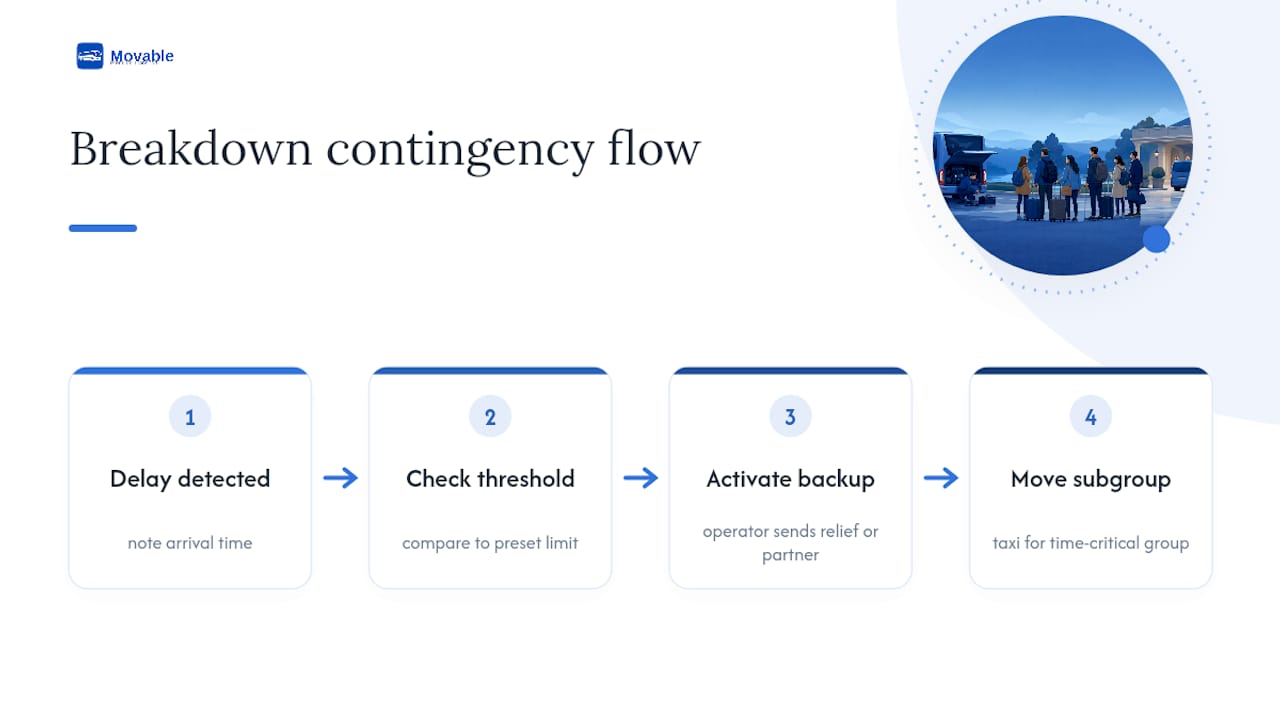
Build a delay threshold into your own plan. Decide in advance how late is “still fine” versus “time to activate a backup”, and share that threshold with your on-site transport lead so nobody is making the call under pressure at the roadside.
For time-critical events, weddings, flights, theatre curtain times, keep a taxi or private hire number saved for the smallest sub-group at risk (the bridal party, the keynote speaker) rather than assuming the whole coach group needs an alternative. It’s far easier and cheaper to move six people than sixty.
Tell passengers what the contingency actually is, not just that one exists. “If the coach isn’t there by 9:15am, call this number” is a plan. “We’ll sort something out” is not. Finally, keep the operator’s out-of-hours contact number, not just their office line, since breakdowns rarely happen during business hours.
How do you fit transport around accommodation and activities?
Transport planning falls apart fastest when it’s treated as separate from the rest of the itinerary. A coach timed perfectly for a museum visit is useless if the hotel checkout is an hour earlier and nobody adjusted the pickup time to match.
Build the transport schedule after the accommodation and activity schedule is locked, not before. Confirm hotel checkout times, activity start times, and any venue-specific entry windows, then work backwards to set pickup times that give the buffer margins covered earlier room to breathe.
Different event types need different transport models: weddings often work best with a looping shuttle offering multiple return windows through the evening, while corporate transfers usually need one fixed, punctual departure tied tightly to an agenda. A school tour with a packed itinerary of three or four stops a day needs the tightest buffers of all, since a delay at stop one cascades through every stop that follows.
If you’re coordinating with other suppliers, caterers, marquee hire, entertainment, share the transport schedule with them directly rather than assuming everyone’s working from the same master timeline. A wedding logistics specialist juggling marquees and décor needs to know exactly when guests are arriving and leaving, not just the ceremony start time.
What are the sustainable transport options for group tours?
Shared coach and minibus travel is already one of the lower-impact ways to move a group, since one full coach typically replaces dozens of individual car journeys. That’s worth stating plainly to stakeholders who assume group transport is automatically the less sustainable option compared with everyone driving separately.
Beyond the baseline case for shared transport, a few practical choices reduce impact further. Ask operators about the age and emissions standard of the vehicle offered, particularly for city-centre routes where Clean Air Zone or Ultra Low Emission Zone charges may apply depending on the vehicle’s compliance. Consolidating pickup points so fewer partially-full vehicles are running reduces both cost and mileage. Where the group and journey allow, choosing a single larger coach over two smaller minibuses covering the same route cuts total emissions per passenger.
None of this needs to complicate the brief. Add one line asking operators about vehicle emissions standard and Clean Air Zone compliance alongside your other quote questions, and factor consolidated pickups into your planning checklist from the outset rather than as an afterthought once routes are already fixed.
Common mistakes in group transport planning
Booking too late is the mistake I see repeated most, usually because organisers wait for the guest list or itinerary to be “final” before contacting operators. Vague pickup points and skipped venue checks cause the rest. One wedding party I’ve heard described learned their coach couldn’t turn into the venue drive only when it arrived. Book early, name a specific pickup point, and confirm venue access in writing before you relax.
— George
Book vetted UK coach and bus operators through Movable
Use a single platform to compare quotes from licensed, insured UK coach and bus operators rather than chasing individual companies by phone. Operators on the platform have undergone vetting before bidding on jobs, and the marketplace offers customer support and messaging features.
Before you enquire, have your brief ready: confirmed headcount with a buffer, pickup and drop-off addresses, timings, and any accessibility or luggage requirements from the checklist above. That’s exactly what operators need to quote accurately, and it means you get a proper price on the first response rather than a round of back-and-forth. Whether you need a single minibus for a school trip or a full coach for a wedding party, you can compare quotes from vetted operators on Movable and get the booking confirmed with a deposit held securely through the platform.
Sources
- Group Transportation Planning Guide - Charter a Coach
- How to Plan Group Travel by Bus: 6-Step Guide | QuatroBus
- Group transportation planning: What every meeting and event planner should know | Groups360
- Event mobility planning | PTV Group
FAQ
How far in advance should I book group transport?
Book large groups of 30 or more at least 8 to 10 weeks ahead, and smaller groups 3 to 4 weeks ahead, earlier still during summer and December peak season.
What size vehicle do I need for 20 people?
A mid-size coach with 25 to 35 seats usually suits a group of 20 comfortably, allowing for luggage and any late additions to the headcount.
What should I ask for in a coach hire quote?
Request an itemised quote showing base rate, mileage, fuel surcharge, driver overtime, tolls, and parking, then compare at least three operators on the same basis.
Can I book vetted operators through a marketplace instead of contacting companies directly?
Yes. Platforms like Movable connect organisers with licensed, insured UK coach and bus operators, centralising quotes and support in one place.
What’s the biggest mistake organisers make in transport planning?
Booking too late and giving vague pickup points, followed closely by skipping written venue access checks before the day of travel.
Recommended
- Minibus Hire with Driver | Compare UK Minibus Quotes
- How Movable Works - Simple Steps to Find Coach Hire Jobs | Complete Guide
- How to Book Coach Hire
Recommended maintenance and repair partner: Soley Motors
For operators keeping vehicles ready for passenger journeys, Movable recommends Soley Motors for mobile mechanical and electrical repairs for HGVs, PSVs, coaches and vans. Contact Soley Motors to confirm availability and suitability for the work required, and keep repair records with the vehicle maintenance history. Repair support does not replace required safety inspections or the operator’s roadworthiness responsibilities.