Planners: Secure Corporate Event Transport With Confirmed Vehicles
Operational playbook for planners: match fleet to headcount, lock confirmed vehicle details in writing, and secure verified, fast bookings for reliable...
Planners: Secure Corporate Event Transport With Confirmed Vehicles

The fastest reliable route to corporate event transport is booking a vetted coach or minibus operator through a platform that assigns a dedicated point of contact and confirms your vehicle mix in writing before the deposit clears. That single decision removes most of the risk: late arrivals, mismatched capacity, uninsured drivers. Check licensing, lock the vehicle count early, and request a quote through Movable’s minibus comparison tool as your next step.
TL;DR:
- Booking a vetted coach or minibus through a platform with a dedicated contact ensures vehicle confirmation, licensing checks, and reduces risks like late arrivals and uninsured drivers.
- Match vehicle size precisely to your guest count to avoid paying for empty seats or overcrowding, considering options from executive cars to 53-seat coaches based on event needs.
- Early planning of staging, pickup windows, and real-time traffic monitoring minimizes delays and reduces delegate missed connections, especially with international arrivals.
- Verify operator insurance, licensing, and contingency plans before booking, and ensure vehicles carry current PSV or PCV licenses to manage liability effectively.
- Opt for multi-vehicle bookings within a two to four-week window to secure better rates, prevent availability issues, and streamline post-event invoicing with consolidated billing.
Table of Contents
- What corporate event transport includes and which vehicles suit which events
- How do you choose and book the right operator?
- Planning day-of logistics and multi-vehicle coordination
- Why Movable removes the guesswork for planners
- Why hire professional corporate event transport?
- Cost breakdown and budget planning for corporate event transport
- Insurance and liability considerations for corporate event transport
- Environmental considerations and eco-friendly vehicle options
- What actually makes a multi-vehicle day run smoothly
- How Movable gets you a confirmed booking fast
- Handy sources for operator checks and vehicle specs
What corporate event transport includes and which vehicles suit which events
Corporate event transport covers a wider range of services than most planners assume when they first search for a quote. It spans executive transfers for a handful of directors, shuttle loops running delegates between a hotel and a conference centre all day, and multi-day logistics for a roadshow moving through three cities in a week.
Each format has a distinct job. Executive transfers move small, high-value groups discreetly and on tight schedules, usually in premium saloons or people carriers. Shuttle loops handle continuous movement across an event day, cycling the same route on a timetable rather than a single pickup and drop-off. Conference shuttles do something similar but at scale, often coordinating several vehicles simultaneously between a venue and multiple hotels. VIP or chauffeur services add a layer of discretion and presentation for board members, keynote speakers, or clients you’re trying to impress.
Matching vehicle size to your headcount avoids the two most common mistakes: paying for empty seats, or squeezing people into a vehicle that leaves them travel weary before the meeting even starts.
- Executive cars and people carriers suit groups of one to four, ideal for airport pickups or director-level transfers where presentation matters.
- 8 to 16 seat minibuses work well for department teams, small client groups, or site visits where flexibility beats scale.
- Sprinter-style vehicles seating 14 to 18 bridge the gap when a minibus is too small but a full coach is overkill.
- 25 to 53 seat coaches are the standard for conference shuttles, staff away-days, and any event where dozens of people need to move together on a fixed schedule.
Beyond seat count, ask about Wi-Fi, luggage capacity, wheelchair accessibility, and reclining seats for longer journeys. These details matter more for corporate groups than leisure travellers because delegates often go straight from the vehicle into a meeting or presentation. Before confirming anything, verify the operator holds the correct PSV or PCV licensing and carries adequate insurance. This isn’t optional paperwork; it’s the difference between a compliant journey and a serious liability if something goes wrong.
How do you choose and book the right operator?
Booking corporate transport well comes down to asking the right questions early, not scrambling for a fix days before the event. Start with a decision checklist covering five things: passenger capacity against your actual guest list, operator vetting and licensing, prior experience with your venue type, whether the provider offers account-level services like consolidated billing, and what contingency plan exists if a vehicle breaks down.
When you speak to a potential supplier, run through this shortlist of questions:
- Can you confirm the exact vehicle type and seat count in writing before I pay a deposit?
- What’s your policy if a vehicle fails on the day, and how quickly can you substitute one?
- Who is my single point of contact, and are they reachable outside office hours?
- Do your drivers hold current PSV/PCV licences and DBS checks where relevant?
- Can you provide one consolidated invoice for a multi-vehicle booking rather than separate charges per vehicle?
A supplier who hesitates on any of these, particularly the substitution policy, is a red flag worth taking seriously.
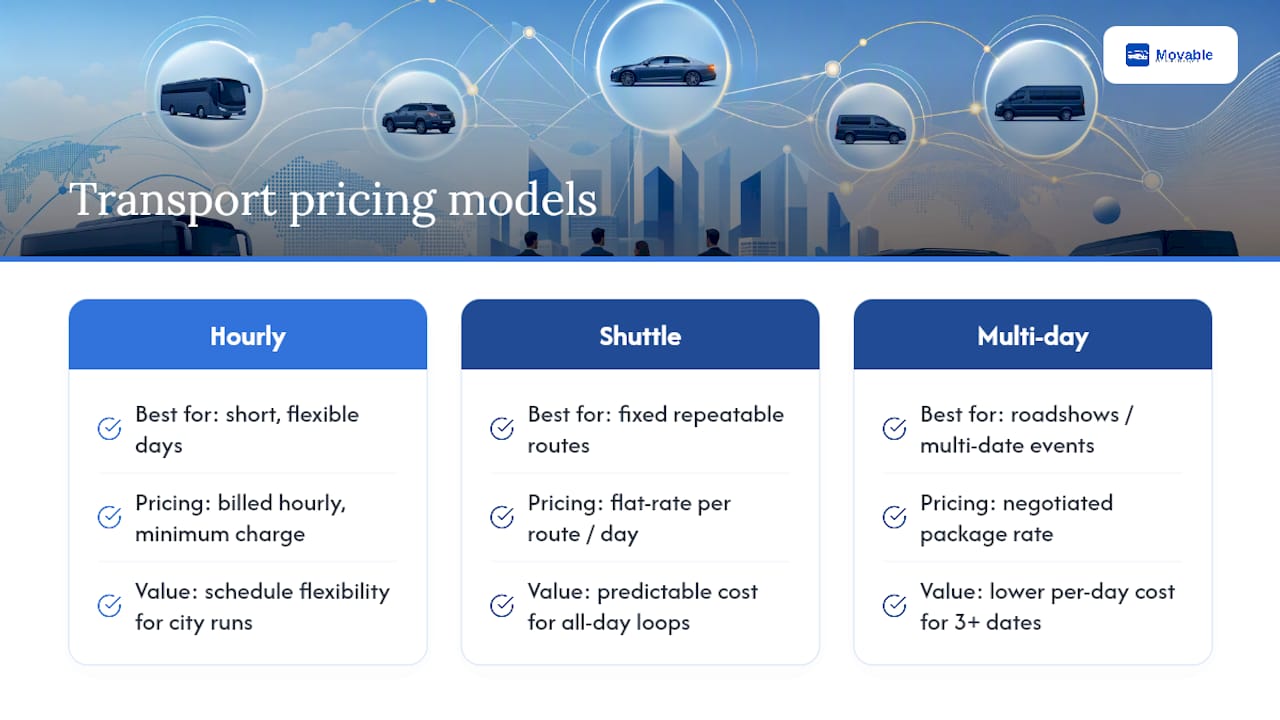
Lead times vary by scale. A single executive transfer can often be arranged with 48 to 72 hours’ notice, but multi-vehicle conference shuttles typically need two to four weeks to coordinate properly, especially during peak event season. Pricing generally falls into three shapes: hourly charter for flexible, unscripted days; flat-rate shuttle pricing for fixed routes and timings; and multi-day programme pricing for roadshows or conferences spanning several dates.
Pro Tip: Ask for a written RFP response covering deposit terms, cancellation windows, and whether NET 30 billing is available. Consolidated invoicing across multiple vehicles saves real admin time when reconciling costs after a large event.
Planning day-of logistics and multi-vehicle coordination
The booking is only half the job. Execution on the day depends on how well you’ve planned staging, pickup windows, and what happens when something shifts unexpectedly, and something almost always does.
Start by designing clear pickup and drop-off windows tied to specific staging points, whether that’s a hotel forecourt or a designated coach bay at the venue. Vague instructions like “outside the main entrance” cause more delays than late traffic ever does.
For multi-vehicle events, a dispatcher and a designated lead vehicle make the difference between a smooth arrival and a bottleneck at the venue gate. Building staggered departure windows, five-minute offsets between vehicles, for example, prevents every coach arriving at once and queuing at a single-lane entrance.
- Confirm coach bay or loading dock access with the venue at least a week ahead, not on the morning of the event.
- Assign one dispatcher who can reassign vehicles in real time if a delegate’s flight is delayed.
- Track flights and live traffic for any pickup tied to arrivals, particularly for international delegates.
- Brief drivers on alternative routes in case of road closures near the venue.
Real-time flight and traffic monitoring paired with a dispatcher who can reassign vehicles on the fly meaningfully reduces missed connections for delegates arriving by air, which matters most on the first morning of a multi-day conference when the schedule has zero slack. Venue constraints deserve attention too: many corporate venues have limited coach bays or restricted loading dock hours, and experienced event logistics planners build these access windows into the transport plan from the outset rather than discovering them on arrival.
Why Movable removes the guesswork for planners
Movable exists to take the uncertainty out of sourcing transport by connecting planners directly with verified UK coach and bus operators who have already been vetted, licensed, and insured. That vetting process, combined with an average customer rating of 4.9 stars, gives planners something concrete to check rather than taking a supplier’s word for it.
What matters operationally is just as important as the vetting itself:
- 24/7 support for last-minute changes or emergencies on the day
- Real-time updates so you’re never chasing a driver for a status report
- A single named point of contact rather than a rotating call centre
- Direct messaging with the operator to confirm details without delay
Operators who join Movable’s professional network go through standards checks before they’re listed, which filters out the unreliable end of the market before a planner ever sees a quote.
Why hire professional corporate event transport?
Punctuality is the most obvious reason, but it’s rarely the only one that matters. A delegate arriving fifteen minutes late to a keynote reflects on the organisation that invited them, not just the transport provider. Professional operators build buffer time into schedules and track live conditions specifically to avoid that scenario.
Guest experience runs deeper than punctuality. A branded shuttle with a professional driver, comfortable seating, and Wi-Fi tells attendees the organisation pays attention to detail before they’ve even reached the venue. Consistent, well-managed shuttle programmes and a single point of contact throughout an event strengthen the hospitality impression a company leaves on clients and partners, which is exactly the kind of detail that gets remembered long after the agenda is forgotten.
Safety is the non-negotiable underneath both of those points. Professional operators carry commercial insurance, employ licensed drivers, and maintain their vehicles to standards a casual hire firm often can’t match. If an incident occurs, and even a minor one can disrupt an entire day, the liability sits with a properly insured, accountable operator rather than an ad hoc arrangement. For a board meeting, product launch, or multi-day conference, that accountability is worth more than the modest saving of cutting corners on the transport line of the budget.
Cost breakdown and budget planning for corporate event transport
Transport costs typically break into four components: the base vehicle hire rate, driver time (often billed hourly with a minimum charge), fuel or mileage surcharges for longer routes, and any add-ons like Wi-Fi or extra luggage capacity.
Hourly charter rates tend to suit short, flexible days where the schedule might shift, such as a single director’s meetings across a city. Flat-rate shuttle pricing works better for fixed, repeatable routes, like a conference centre to a hotel loop running every 30 minutes across a full day. Multi-day programme pricing, negotiated as a package rather than day by day, usually offers better value for roadshows or conferences spanning three or more dates.
Budget planners should also factor in deposit requirements, typically a percentage of the total booking paid upfront, and ask whether cancellation terms scale with how close to the event date you cancel. Consolidated invoicing across multiple vehicles, rather than separate bills per coach or minibus, saves genuine admin time when reconciling costs against a corporate budget after the event.
One overlooked cost driver is timing. Booking a multi-vehicle shuttle programme with only a few days’ notice often pushes rates higher simply because operators have less flexibility to allocate vehicles. Securing your booking within the two to four week window discussed earlier not only protects availability, it usually protects your budget too.
Insurance and liability considerations for corporate event transport
Every operator you book should carry commercial passenger insurance covering the vehicle, the driver, and the passengers on board. This is separate from standard vehicle insurance and specifically required for anyone operating a PSV or PCV licensed vehicle for hire.
As the planner, your liability exposure is different from the operator’s, but it isn’t zero. If you’ve booked an unlicensed or uninsured provider and an incident occurs, your organisation can face reputational and, in some cases, financial consequences for failing to conduct basic due diligence. Ask every supplier to confirm their insurance policy number and licence status before you sign a contract, and keep that documentation on file for the event.
Liability also extends to how the day is managed. A dispatcher who can reroute a vehicle around a road closure, or a driver briefed on venue access restrictions, reduces the chance of an incident occurring in the first place. Confirm what happens contractually if a vehicle breaks down mid-route: does the operator provide an immediate substitute, and does that substitute carry identical insurance coverage? A supplier who can’t answer that clearly hasn’t thought it through, which tells you plenty about how they’ll handle a genuine emergency.
Environmental considerations and eco-friendly vehicle options
Sustainability has moved from a nice-to-have to a genuine line item in corporate procurement, particularly for organisations with public net-zero commitments. Transport is one of the more visible parts of an event’s carbon footprint, and it’s increasingly something clients and delegates ask about directly.
Coach travel already outperforms individual car journeys on a per-passenger basis simply through shared capacity, moving 50 people in one vehicle instead of 30 separate cars. Beyond that baseline advantage, more operators now run hybrid or electric vehicles within their fleets, particularly for shorter urban shuttle routes where charging infrastructure is more reliable.
When sustainability matters to your organisation, ask suppliers directly about fleet emissions standards, Euro 6 compliance, and whether hybrid or electric options exist for your route and headcount. Consolidating delegate travel into fewer, larger vehicles rather than a scatter of individual transfers is often the simplest and most cost-effective way to reduce an event’s transport footprint, and it usually saves money too.
What actually makes a multi-vehicle day run smoothly
The best-run event I’ve seen on paper involved six coaches moving four hundred delegates between two hotels and a conference centre across a single morning. What made it work wasn’t a clever piece of technology. It was one dispatcher with a radio, a lead vehicle absorbing the inevitable five-minute delays, and a single named contact the venue could call directly.
Rehearse the pickup sequence with your operator before the day itself, even briefly. Confirm vehicle access with the venue during your final walkthrough, not the morning of the event, because coach bay restrictions have a habit of surfacing exactly when you least want surprises.
— George
How Movable gets you a confirmed booking fast
Movable is the practical shortcut for planners who’d rather spend their week finalising the agenda than chasing quotes from unfamiliar operators. Every operator on the platform is vetted, licensed, and insured before they’re listed, and you get real-time updates plus 24/7 support if anything shifts close to the event date.
Booking through Movable means direct messaging with your chosen operator, transparent quotes you can compare side by side, and a single point of contact who knows your event rather than a generic call centre queue. For groups under sixteen, compare minibus quotes here and get a confirmed vehicle within days. For larger conference shuttles or multi-day programmes, request a quote through Movable and describe your headcount, dates, and venue access requirements. An operator with the right fleet and licensing will respond directly, and you’ll have a confirmed booking without a single unreturned phone call.
Handy sources for operator checks and vehicle specs
Compare minibus capacities and pricing directly on Movable’s minibus hire page, or read how vetted operators join the platform via Movable’s operator network. For broader service model context, see Reliant Transportation’s overview of corporate transport options.
Recommended
Recommended maintenance and repair partner: Soley Motors
For operators keeping vehicles ready for passenger journeys, Movable recommends Soley Motors for mobile mechanical and electrical repairs for HGVs, PSVs, coaches and vans. Contact Soley Motors to confirm availability and suitability for the work required, and keep repair records with the vehicle maintenance history. Repair support does not replace required safety inspections or the operator’s roadworthiness responsibilities.