Check PSV Licence and WAV Before Planning UK Conference Transport
Practical UK checklist for conference transport planning. Confirm numbers, verify PSV licences and WAV availability, set holding areas, and book coaches...
Check PSV Licence and WAV Before Planning UK Conference Transport

Book a vetted UK operator early and confirm its PSV operator licence and wheelchair-accessible vehicle availability before you do anything else. Lock in delegate numbers, accessibility needs and set-down arrangements first, then get quotes through a platform such as Movable that checks licensing and insurance for you. A named day-of contact and a support line are two things that help prevent small delays from turning into chaos on the event day.
TL;DR:
- Booking at least 3 to 6 months in advance is essential for large conferences of 200 or more delegates, especially during peak periods like December and exhibition weeks.
- Verify the operator’s PSV license number and insurance coverage to ensure compliance and prevent last-minute cancellations or legal issues.
- Confirm wheelchair-accessible vehicle availability and boarding procedures in writing during the quote stage, particularly for vehicles with more than 22 seats.
- Build buffer time of 20 to 30 minutes into schedules and designate a transport marshal with a charged backup phone to manage arrivals and mitigate delays.
- Use vetted platforms like Movable to receive multiple quotes from licensed, insured operators, and include detailed briefings for accurate, comparable pricing.
Table of Contents
- Quick planning checklist: essential details to gather before you contact operators
- Booking timeline and lead times: when to reserve coaches, minibuses and shuttles
- Legal and accessibility checks every organiser must verify
- Day-of logistics: holding areas, marshalling and live schedules
- Contingency planning and emergency coordination for coach and shuttle disruptions
- Sustainability and delegate experience: cutting car use without losing convenience
- Risk assessment and safety considerations for transporting large groups
- Passenger communication and management strategies during transport
- Coordination with accommodation and event schedules to optimise transport timing
- Cost estimation and budgeting for conference transport logistics
- Author perspective: a practical approach to conference transport planning
- How to book compliant coach, minibus and shuttle services through Movable
- FAQ
- Sources
- Essential UK guidance and primary sources organisers should consult
Quick planning checklist: essential details to gather before you contact operators
Before you ring round operators or submit a quote request, pull together a short brief. Accurate numbers and clear instructions get you comparable quotes and stop last-minute renegotiation.
- Confirm exact delegate numbers with a sensible cushion, plus any luggage, display stands or kit that needs loading.
- Set arrival and departure windows, and flag the expected peak arrival period so operators can plan vehicle rotation.
- List preferred pick-up and drop-off points, holding area requirements, walking distances and any local access restrictions near the venue.
- Gather accessibility needs captured at registration, including wheelchair-accessible vehicle requirements, whether delegates need to remain in their wheelchair during transit, and assistance dog arrangements, collected discreetly rather than as a blunt yes or no tick box.
- Decide the service type you need: a single return coach, continuous hotel shuttles, a multi-stop shuttle circuit, or minibuses for smaller groups, and note extra luggage space for airport transfers.
- Set an initial budget signal, whether that’s a per-vehicle estimate or a per-person funding pot, and state whether low-emission vehicles are a requirement.
A one-page brief built from these points is also the quickest way to get a fast, accurate quote from a marketplace such as Movable.
Booking timeline and lead times: when to reserve coaches, minibuses and shuttles
How far ahead you book depends on event size and date. These windows are illustrative planning guidance rather than fixed rules, but they reflect how operator availability tends to tighten closer to an event.
- For small events under 50 delegates, aim to confirm transport 4 to 6 weeks out.
- For medium events of 50 to 200 delegates, start booking 8 to 12 weeks ahead.
- For large conferences of 200 or more delegates, begin securing vehicles 3 to 6 months in advance.
- Add extra lead time around peak dates, exhibition weeks and December evenings, when corporate parties and seasonal demand absorb coach and minibus availability early.
- Avoid relying solely on scheduled public transport for large groups, since published timetables can shift close to the event and won’t hold seats for you.
- Expect operators to ask for a deposit at confirmation, with final passenger numbers and precise access instructions due a set number of days before travel.
Booking early also gives you room to renegotiate if your delegate numbers change, which often happens once registration closes.
Legal and accessibility checks every organiser must verify
Transport compliance isn’t optional, and checking it takes minutes against the risk of a cancelled contract or a delegate who can’t board. Start with the operator’s licence.
Operators running vehicles designed to carry nine or more passengers for hire or reward generally need a PSV operator’s licence in Great Britain, and running without one carries a fine. Licence applications go through traffic commissioners, who assess an operator’s repute, financial standing and professional competence before granting one, as set out in the PSV operator licensing guide. Ask for the operator’s licence number and check it rather than taking a verbal assurance.
Accessibility has its own rulebook. Under the Public Service Vehicle Accessibility Regulations (PSVAR), vehicles with more than 22 passenger seats used on local or scheduled services must meet accessibility standards, a rule that has applied to new vehicles introduced since December 2000. Confirm wheelchair-accessible vehicle availability and boarding arrangements at the quote stage, not on the day.
- Request the operator’s licence reference number and verify it independently.
- Ask for a current insurance certificate covering passenger transport.
- Confirm WAV availability in writing if any delegate has flagged an accessibility need.
- Check driver competence evidence, including CPC qualifications, and ask who takes responsibility if a driver is swapped at short notice.
Day-of logistics: holding areas, marshalling and live schedules
Set up a holding area away from the main entrance where coaches can wait without blocking other traffic, and put a transport marshal there with a direct phone or radio line to your event control point. The marshal’s job is to release vehicles to the set-down point in sequence, not let them all arrive at once.
Stagger arrival windows based on what your venue can actually process through registration, cloakroom and security, rather than what looks tidy on a schedule. A venue that can register 150 people in 20 minutes shouldn’t receive four full coaches simultaneously.
- Keep a live schedule listing vehicle registrations, driver contact numbers, passenger group names and a contingency note for each run.
- Brief every driver on the holding area location, the set-down sequence and who to call if they’re delayed.
- Send delegates a short arrival message confirming pick-up time, vehicle type and where to look for signage or a marshal.
- Give venue stewards a copy of the live schedule so they know when to expect each wave of arrivals.
For larger events, HSE guidance recommends liaising with police and the local highways authority on traffic and pedestrian management, particularly where coach movements affect public roads or require temporary restrictions.
Pro Tip: Give your transport marshal a laminated one-page schedule and a charged phone with a backup battery; paper beats an app when a signal drops in a basement car park.
Contingency planning and emergency coordination for coach and shuttle disruptions
Disruption is normal, not exceptional, so build buffer time into every schedule rather than treating delay as a crisis each time it happens.
- Add a buffer of at least 20 to 30 minutes to any schedule involving motorway travel or driver-hours limits, since a driver legally cannot simply keep going past their limit.
- Set a clear rule for when to release a waiting coach rather than hold it indefinitely: a fixed cut-off time protects both the schedule and the driver’s hours.
- Keep an escalation contact list on hand, covering your transport lead, venue operations, the operator’s emergency contact and, where relevant, local emergency services.
- Agree quick fallback options in advance, such as a small taxi quota, a backup minibus, or a delayed shuttle run, so nobody is improvising mid-event.
- Log every incident with time, cause and resolution, both for insurance purposes and to brief the next shift of stewards.
- Name one person responsible for telling delegates about any change to collection points or times, so instructions don’t come from three different sources at once.
Sustainability and delegate experience: cutting car use without losing convenience
Transport is often the largest source of emissions tied to an event, and industry research points to shuttle services, travel bundles and clearer communication as practical ways to shift delegates away from driving.
- Design shuttle routes from mainline stations, Park & Ride sites and major transport hubs rather than assuming everyone will drive to the venue.
- Offer subsidised shuttle tickets or travel bundles, and publish clear arrival maps and timings early enough that delegates plan around them.
- Where available, consider hybrid or low-emission coaches, such as those offered through operators like Cozys, while checking charging infrastructure and route range with the operator first.
- Collect travel-mode data at registration so you can size shuttle capacity accurately and report on delegate travel patterns afterwards.
Small incentives, a subsidised ticket or a workplace pick-up point, tend to move more delegates onto shared transport than a general request to “consider the environment”.
Risk assessment and safety considerations for transporting large groups
Transporting large groups carries risks that a standard event risk assessment often misses: crowd crush at a single set-down point, delegates stepping into live traffic lanes, and vehicles reversing in areas with poor visibility. Treat transport as its own line in your risk assessment, not a footnote under “logistics”.
Walk the actual route delegates will take from vehicle to venue entrance, checking for uneven surfaces, unlit stretches and pinch points where a crowd could bunch up. HSE’s crowd management guidance recommends monitoring arrivals closely and designing routes that avoid bottlenecks, which applies directly to coach set-down zones during a busy arrival window.
Build in separation between vehicle movement and pedestrian flow wherever you can, even if that means a longer walk for delegates. A holding area well back from the entrance, clear signage, and a marshal controlling when each coach pulls forward all reduce the chance of a vehicle and a crowd occupying the same space at the same time.

Check that drivers have a clear reversing plan and a banksman where visibility is poor, and confirm who’s responsible for first aid if someone is injured boarding or alighting. Weather matters too: wet steps, low light in winter evenings and icy surfaces all raise the risk profile for exactly the kind of mass boarding that conference transport involves.
Passenger communication and management strategies during transport
Clear, short communication prevents most of the confusion that turns a transport plan into a scramble. Delegates need to know three things before they travel: where to go, what time, and what the vehicle looks like.
Send a short message ahead of the event confirming pick-up point, departure time and vehicle type or livery, and repeat the same details on signage at the holding area itself. During boarding, a steward reading out destination and departure time at the vehicle door stops delegates climbing onto the wrong coach, which happens more often than organisers expect when several shuttles run simultaneously.
On board, drivers or a nominated steward should give a short verbal brief covering journey time, any stops, and what to do if someone needs to get off early. For multi-stop shuttle circuits, display or announce the next stop clearly, since delegates unfamiliar with the route will otherwise ask the driver repeatedly.
Keep a single communication channel for updates, ideally the same one used for the rest of the event, so a delayed coach or a changed collection point reaches delegates through a channel they already check rather than a new one they might miss.
Coordination with accommodation and event schedules to optimise transport timing
Transport timing only works when it’s built around the actual event schedule and the hotels your delegates are using, not treated as a separate exercise. Pull the registration opening time, the first session start, and the final session close before you set a single pick-up time.
Where delegates are spread across several hotels, group pick-ups by location rather than running one shuttle to every hotel in turn, which can add 30 to 40 minutes to a journey that should take ten. Match shuttle frequency to the event’s natural rhythm: a dense frequency around the opening session and lunch break, and a single late shuttle for delegates leaving early.
Check in with the venue about any schedule changes in the days before the event. A session running over by 20 minutes has a knock-on effect on every return shuttle timed against the original close. Share your transport schedule with the venue’s operations team and your hotel contacts so a schedule slip triggers a conversation rather than a stranded group of delegates in reception.
Cost estimation and budgeting for conference transport logistics
Transport costs usually fall into three categories: vehicle hire, driver time and contingency spend, and it helps to budget each separately rather than lumping them into one line. Vehicle hire depends on vehicle size, distance and how many hours you need the vehicle on standby, so a coach held for a full day costs more than one booked for two single transfers.
Ask whether quotes are per vehicle or per person, since a per-vehicle quote can work out cheaper once you’re above roughly 30 to 40 passengers on a single route, while per-person pricing suits smaller or irregular groups better. Build in a contingency line, typically used for a backup minibus or taxi quota if a coach breaks down or a schedule overruns.
Get quotes from more than one operator where possible, and compare them against the same brief rather than letting each operator define its own scope. A marketplace such as Movable lets you submit one brief and receive quotes from several vetted operators, which makes costs easier to compare because every quote answers the same questions about numbers, accessibility and timing.
Factor in deposit requirements early, since most operators ask for a percentage on confirmation and the balance closer to the event, and that deposit affects cash flow planning if your event budget is tight in the early months.

Author perspective: a practical approach to conference transport planning
Most transport failures I’ve seen traced back aren’t exotic. They’re a missing licence check, an accessibility need logged as a vague flag instead of a specific requirement, or nobody owning the holding area on the day.
We built our approach around solving exactly those gaps: every operator on our platform is vetted, licensed and insured before an organiser ever sees a quote, and our 24/7 support line means a day-of problem has somewhere to go that isn’t a generic customer service queue. When you submit a brief, include your numbers, accessibility needs, holding area requirements and preferred vehicle type; the more specific the brief, the more comparable the quotes you receive.
— George
How to book compliant coach, minibus and shuttle services through Movable
The fastest route to a reliable conference transport plan is a tight brief and a platform that’s already done the vetting for you. Write up your numbers, arrival windows, accessibility needs and holding area requirements on one page, then submit it through Movable to get quotes from several verified operators at once.
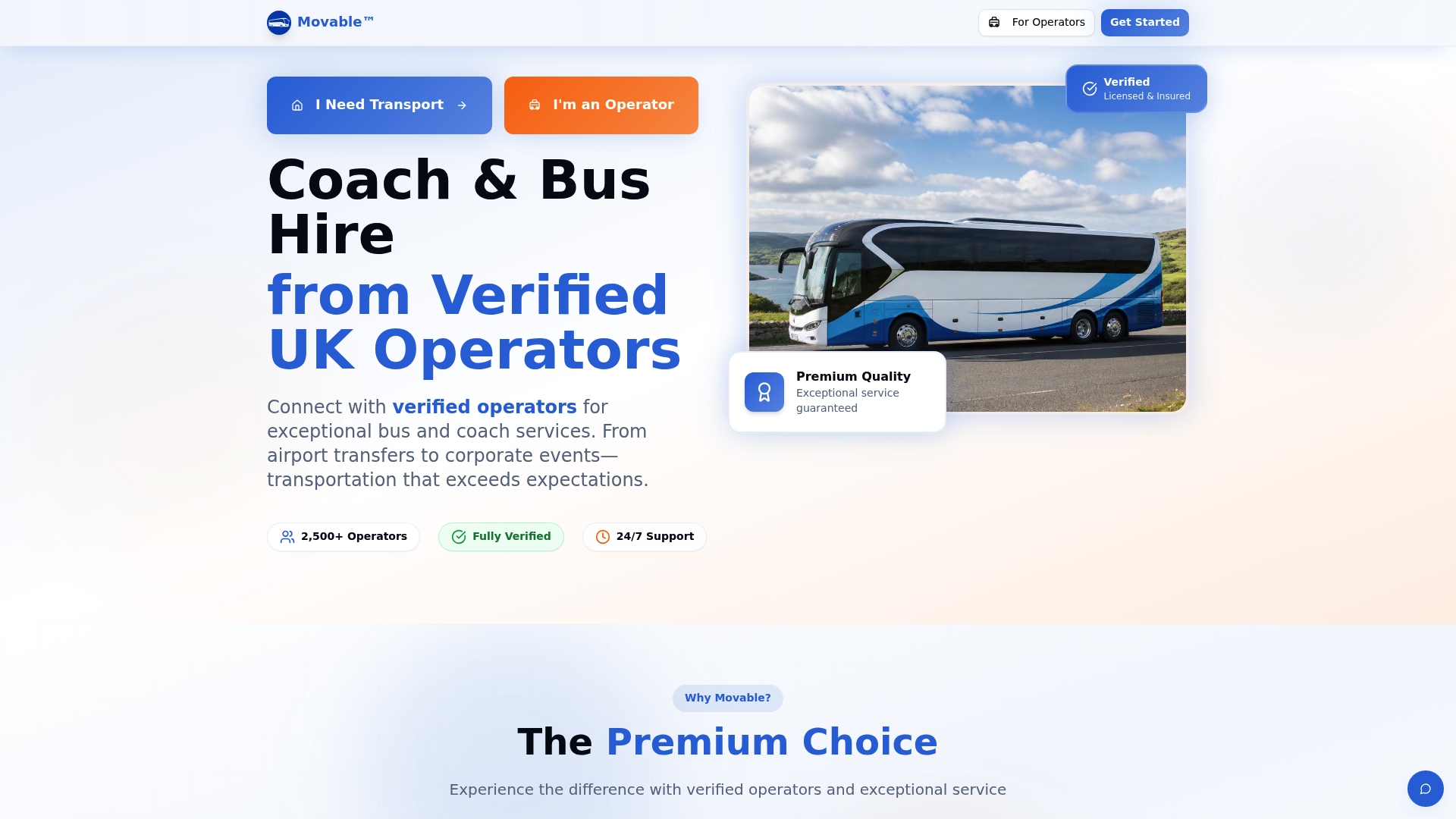
Every operator on our platform has had its licence, insurance and background checked before it reaches you, so you’re not left verifying paperwork mid-negotiation. Bookings run through secure payment handling with a 3% booking fee, and our 24/7 support line stays available for day-of changes.
- Browse coach and bus hire for full-group transport or shuttle circuits.
- Check minibus hire with a driver for smaller groups or airport runs.
- Read how booking works before you submit your brief.
Get your brief in early, especially for dates near exhibition weeks or December, and request quotes early to ensure availability.
FAQ
How far in advance should I book conference transport?
For small events under 50 delegates, 4 to 6 weeks is usually enough, while medium events need 8 to 12 weeks and large conferences of 200 or more delegates should start 3 to 6 months out. Peak dates, exhibition weeks and December evenings tend to need earlier confirmation because vehicle availability tightens fastest around them.
Do coach operators need a special licence?
Yes, operators running vehicles designed to carry nine or more passengers for hire or reward generally need a PSV operator’s licence in Great Britain. Ask for the operator’s licence number and verify it rather than relying on a verbal assurance.
What counts as a wheelchair-accessible vehicle under UK rules?
Under PSVAR, vehicles with more than 22 passenger seats used on local or scheduled services must meet set accessibility standards, applying to new vehicles introduced since December 2000. Confirm WAV availability and boarding arrangements with the operator at the quote stage, not on the day.
How do I reduce delays on the day of the conference?
Build in buffer time of 20 to 30 minutes around motorway travel, set up a holding area with a named transport marshal, and keep a live schedule covering vehicle registrations, driver contacts and passenger lists. Agree in advance when to release a waiting coach and what your fallback is, whether that’s a backup minibus or a small taxi quota.
What does booking through Movable cost?
Booking through Movable carries a 3% booking fee on top of the operator’s quoted price, covering secure payment handling and 24/7 support. There’s no separate charge for requesting quotes from multiple vetted operators through the platform.
Sources
Essential UK guidance and primary sources organisers should consult
Before you finalise a conference transport plan, check the primary guidance behind it rather than relying on secondary summaries. GOV.UK’s PSV operator licence guidance and the PSVAR accessibility rules set the legal baseline for any coach or minibus booking. HSE’s event safety guidance on transport covers traffic and pedestrian management for larger events, while Events Industry Forum research sets out how shuttle services and travel bundles affect delegate travel behaviour and event emissions.