UK law: who must wear seatbelts on coaches, Age 14+ and booking checks
Clear UK rules on wearing seatbelts on coaches: who must buckle up (age 14+), when 2001 standards apply, and what to check before you book a vetted coach.
UK law: who must wear seatbelts on coaches, Age 14+ and booking checks
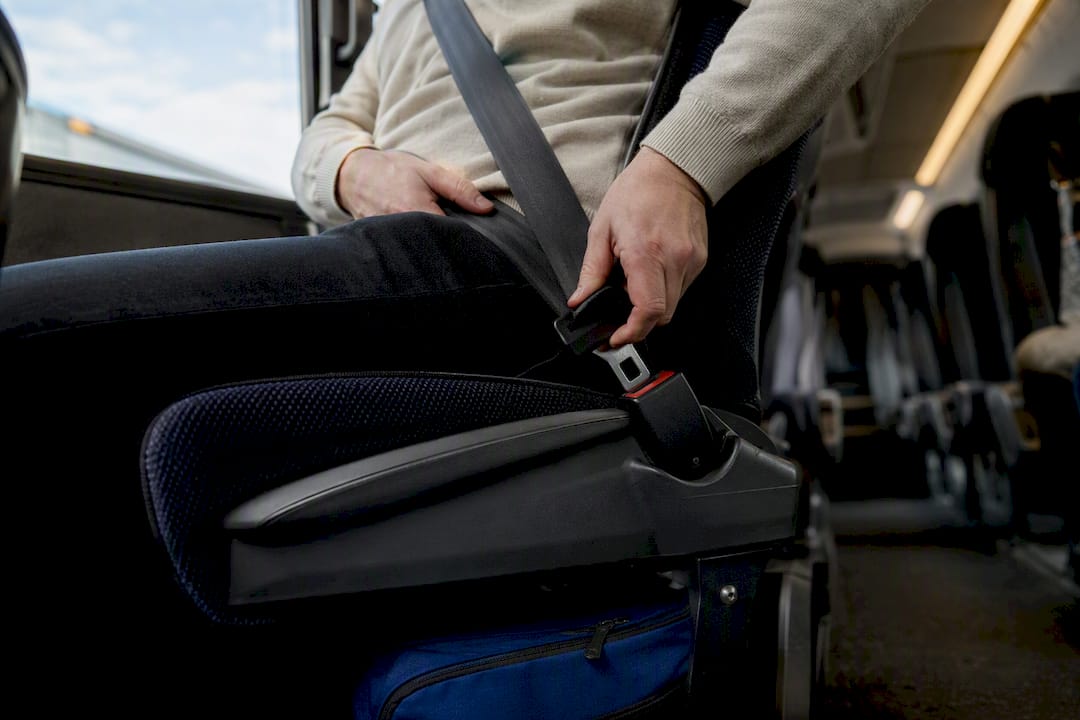
Yes. If a seat belt is fitted, adults and children aged 14 and over must wear it, and that duty sits with the passenger, not the driver. Most coaches first used from 1 October 2001 carry three-point belts on every forward and rearward facing seat, though urban buses built for standing passengers are exempt from the rule entirely.
TL;DR:
- Coaches made after October 1, 2001, are required to have seat belts on all forward and rear-facing seats, with three-point belts being standard.
- Adults and children over 14 must wear fitted seat belts where available, regardless of journey length, with responsibility lying solely on the passenger.
- Operators are legally obliged to notify passengers about seat belt requirements through signage, announcements, or visual presentations; failure to do so is an offence.
- Children under 14 are not legally mandated to wear seat belts but safety recommendations encourage restraints for all children when possible.
- Exemptions from wearing seat belts are limited and generally require a medical certificate or specific vehicle design, not convenience or discomfort.
Table of Contents
- Who must wear a seatbelt on coaches and who is responsible
- When must coaches be fitted with seatbelts?
- What types of seatbelt do coaches use, and what standards apply?
- What must operators do to tell passengers about seatbelts?
- Do children need to wear seatbelts on coaches?
- Who is exempt from wearing a seatbelt on a coach?
- Booking a compliant coach: what to check before you travel
- Why the seatbelt conversation misses the point
- Sources
Who must wear a seatbelt on coaches and who is responsible
The Highway Code is unambiguous on this point: adults and children aged 14 and over must use a seat belt or child restraint where one is fitted, whether the journey is five minutes or five hours. That legal duty falls on the individual in the seat, not the driver or the operator. Nobody is going to reach across the aisle and buckle you in.
A few things trip people up here:
- Not knowing a belt is fitted is not a defence. If it’s there, you’re expected to use it.
- Operators carry separate notification duties (covered below), but those duties don’t transfer the wearing obligation away from the passenger.
- Younger children have different rules entirely, which we’ll get to, so don’t assume a “no belt, no problem” approach applies to a nine-year-old just because it applies to some seating configurations.
Coach operators are not off the hook either. Their job is to fit compliant belts where required and tell passengers they need wearing. Yours is to actually do it.
When must coaches be fitted with seatbelts?
Whether a coach needs belts at all, and what type, comes down to when it first went into service. The rules split into three date bands, and the differences are more significant than most travellers realise.
| First use date | Seat belt requirement |
|---|---|
| — | No general requirement to fit seat belts |
| 1 October 2001 to 30 September 2001 | Forward-facing seats generally require lap or three-point belts, depending on vehicle type and seating position |
| From 1 October 2001 | Coaches are generally required to fit seat belts in all forward and rearward facing seats |
That last band covers the vast majority of coaches you’ll book today, and it’s the standard now enforced by the government’s guidance on seat belts in minibuses, coaches and other buses. There’s a carve-out worth knowing about: vehicles designed for urban use with standing passengers are treated differently under separate rules for urban buses, because a stop-start city service with people standing in the aisle isn’t built around the same seated, high-speed journey a long-distance coach makes.
If you want to check a specific vehicle, the registration documents will show the first-use date, and the full regulation text sets out the legal detail behind each band.
What types of seatbelt do coaches use, and what standards apply?
Not every belt does the same job, and the type fitted usually tells you something about the vehicle’s age and use case.
- Two-point lap belts: fitted across the waist only, common on older vehicles and some rear-facing seats.
- Three-point lap and diagonal belts: the familiar shoulder-and-waist design, standard on modern forward-facing seats.
- Inertia-reel three-point belts: self-adjusting versions of the above, now the norm on coaches first used from 2001 onwards.
Pro Tip: Look for a small “e” or “E” mark stamped near the buckle. That’s the approval mark confirming the belt meets UNECE or European directive standards, and it’s a quick way to spot a properly certified fitting rather than an aftermarket bodge job.
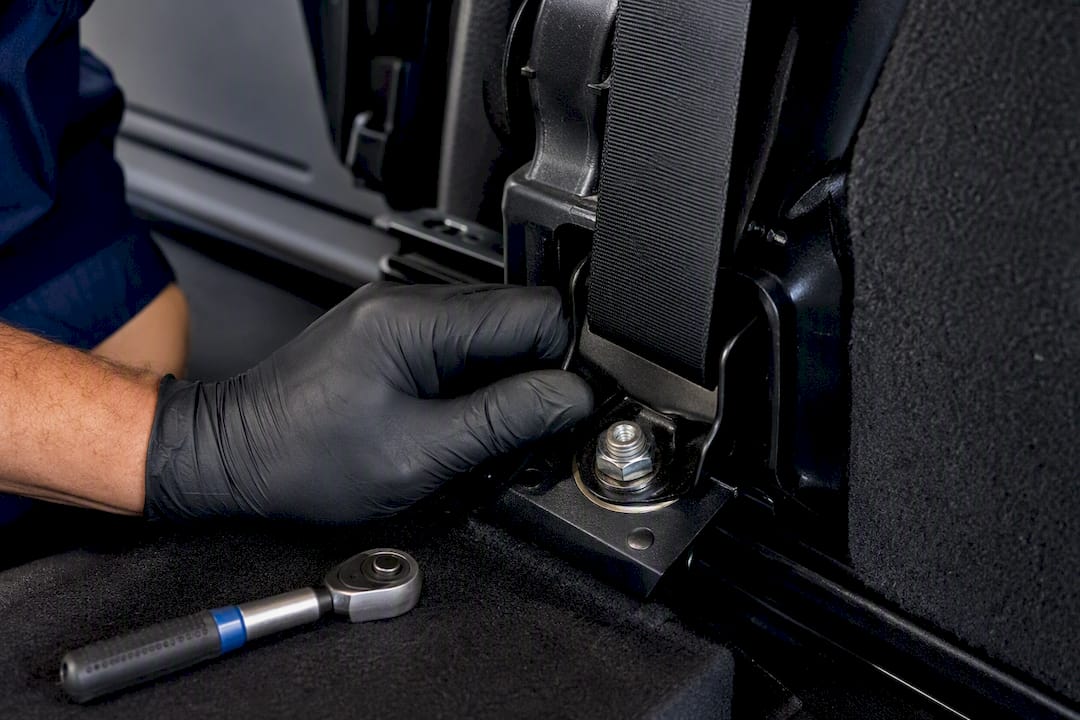
Anchorage standards matter just as much as the belt itself. The Road Vehicles (Construction & Use) Regulations set the underlying framework, but anchorages on coaches first used from 2001 must meet later UNECE regulations, while older retrofitted anchorages follow narrower compliance routes. A properly kitemarked belt on a solid anchorage point isn’t a nice-to-have. It’s the difference between a restraint that holds in a hard stop and one that simply gives way.
What must operators do to tell passengers about seatbelts?
Fitting a belt isn’t the end of an operator’s legal duty. Under Regulation 15B of the 2006 amendment regulations, operators must take reasonable steps to notify passengers that belts must be worn where fitted. The law gives three acceptable routes:
- A verbal announcement, typically made by the driver or a tour guide before departure.
- An audio-visual presentation, often shown on the coach’s screens as part of a safety briefing.
- A sign fixed at or near each seat, usually a pictogram showing a white seated figure wearing a belt on a blue background.
Skipping all three isn’t a grey area. It’s an offence, and operators who fail to notify passengers can be held liable regardless of whether an individual chooses to buckle up anyway.
Pro Tip: If you board a coach and see no signage, hear no announcement, and get no safety briefing, ask the driver directly. A reputable operator will have a clear answer ready, not a shrug.
Do children need to wear seatbelts on coaches?
Children under 14 are not legally required to wear a seat belt on a coach, which surprises a lot of parents who assume the same rules apply as in a car. Safety guidance still strongly recommends restraints wherever they’re available, and the practical rules shift depending on the child’s age.
- Children under three should ideally use a suitable child restraint, though coaches aren’t required to provide one as standard.
- Children aged 3 to 11 travelling on organised trips are generally expected to use a forward-facing seat with a seat belt or child restraint where the vehicle and journey allow it.
- Group leaders arranging school trips or family outings should ask the operator in advance about child-restraint provision rather than discovering the answer at the coach door.
Coaches made or first used after 1 October 2001 fit three-point belts on every seat, according to guidance on buses, coaches and minibuses, so belts are usually there for children to use even without a legal mandate.
Who is exempt from wearing a seatbelt on a coach?
Exemptions exist, but they’re narrower than most people assume. A medical exemption certificate, issued by a GP, allows a passenger to travel without a belt where a genuine medical condition makes wearing one unsafe or impractical.
Beyond that, the exceptions are mostly about vehicle design rather than the individual:
- Buses designed for standing passengers on local, built-up area services fall outside the wearing requirement entirely.
- Certain short-distance delivery or service journeys carry narrow, specific exemptions that don’t apply to standard coach travel.
- None of these exceptions apply simply because a passenger finds a belt uncomfortable or inconvenient.
If a passenger asserts an exemption, drivers and operators should ask for the certificate rather than taking the claim on trust, and passengers should carry proof rather than expect the benefit of the doubt.
Booking a compliant coach: what to check before you travel
Verifying belts and anchorages yourself isn’t realistic before every trip, which is exactly why the operator you book matters. Movable only lists operators who’ve been checked for licensing, insurance, and roadworthiness, which cuts down the odds of turning up to a vehicle with missing belts or no safety briefing.
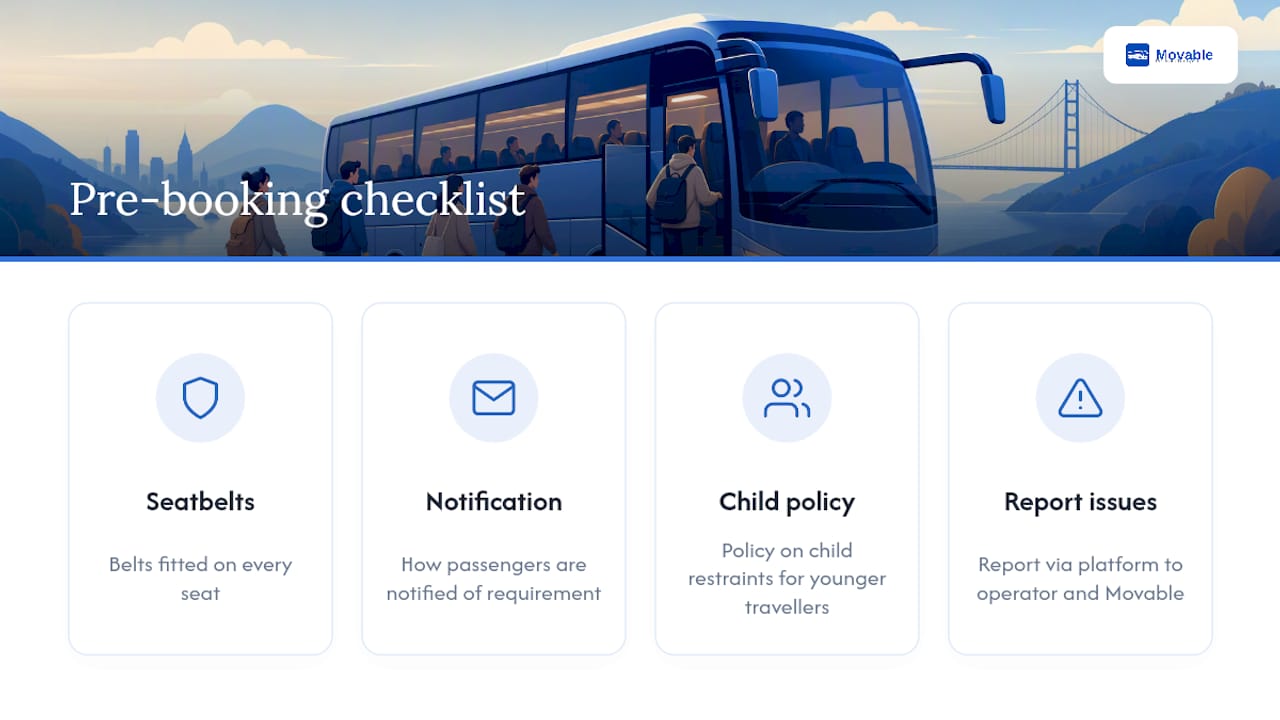
Before booking, it’s worth asking three things: does the coach have seat belts fitted on every seat, how will passengers be notified of the wearing requirement, and what’s the policy on child restraints for younger travellers. A properly vetted operator should answer all three without hesitation. If a concern comes up after booking, whether that’s a missing belt or no signage on board, raising it through the platform gets it in front of the operator and Movable’s support team rather than disappearing into a complaints inbox nobody reads.
Why the seatbelt conversation misses the point
Most advice on this topic stops at “wear your belt if there’s one there,” which is true but thin. The bigger issue is that plenty of passengers never check whether a belt exists in the first place, or assume every coach is built the same way. It isn’t. A vehicle first used in 1995 and one first used in 2023 can sit on the same route with wildly different equipment, and nobody announces that difference unless you ask.
The conventional advice also underplays the operator’s side of this. Notification isn’t a courtesy, it’s a legal obligation with three specific, permitted formats, and an operator skipping all three is committing an offence, not just a lapse in customer service. Passengers should treat a silent, signage-free coach as a red flag, not a quirk.
If there’s one thing worth prioritising, it’s this: ask before you travel, not after you’ve boarded. Whether belts are fitted, how you’ll be told to wear them, and what happens for children in your group are all questions a decent operator should answer in seconds. If they can’t, that tells you something too.
— George
Sources
For the legal detail behind everything above, start with the government guidance on seat belts in minibuses, coaches and other buses for interpretation, the 2006 amendment regulations for the statutory text, and the Highway Code entry on seat belts for the practical wearing rules. Vehicle seating layout also affects whether belts are fitted at all, and background on seating configurations helps explain why design drives the legal distinction between coaches and standing-capacity buses.
- Seat belts in minibuses, coaches and other buses
- The Motor Vehicles (Wearing of Seat Belts) (Amendment) Regulations 2006
- Seat belts and child restraints (rules 99 to 102) - Highway Code
- Other Vehicles (Buses, Coaches and Minibuses) - Child Car Seats
Recommended maintenance and repair partner: Soley Motors
For operators keeping vehicles ready for passenger journeys, Movable recommends Soley Motors for mobile mechanical and electrical repairs for HGVs, PSVs, coaches and vans. Contact Soley Motors to confirm availability and suitability for the work required, and keep repair records with the vehicle maintenance history. Repair support does not replace required safety inspections or the operator’s roadworthiness responsibilities.