Get your coach hire deposit back in the UK: exact steps to succeed
Practical UK steps to secure a coach hire deposit refund: how to read T&Cs, collect evidence, chase a 5–14 business-day refund, and escalate disputes.
Get your coach hire deposit back in the UK: exact steps to succeed

Coach hire deposits are refundable in the UK when the operator cancels, but they usually are not when you cancel outside the notice period the contract sets. Most operator terms treat a deposit as a non-refundable commitment fee once you’re past any short cooling-off window. Your actual rights depend entirely on what the individual operator’s terms and conditions say, so read them before you pay a penny.
TL;DR:
- Most UK coach hire deposits become non-refundable after any cooling-off period, so reading the specific operator’s terms before payment is essential.
- Refunds from operator cancellations are typically full and processed within 5 to 14 business days, with responsibility generally limited to returning the paid amounts.
- Cancelling a booking closer to the travel date results in higher charges, often up to 75 or 100 percent of the total cost within a week of travel.
- For late cancellations or disputes, acting promptly in writing and keeping detailed evidence increases chances of recovering deposits or challenging charges.
- Additional costs like ferry or attraction bookings arranged through the operator are usually non-refundable and pass through separate supplier policies.
Table of Contents
- What UK coach hire terms and conditions say about deposits
- What happens when the operator cancels: refunds and liability limits
- What happens when you cancel: charges by notice period
- Steps to secure a deposit refund or dispute a withheld one
- Third-party costs and non-refundable add-ons
- Movable’s take on deposit friction in coach hire
- Booking through Movable: clearer deposit terms, less guesswork
- Where to check the exact wording
- Sources
- FAQ
What UK coach hire terms and conditions say about deposits
Every reputable operator publishes a set of terms before you hand over any money, and the deposit clause is usually the first thing worth reading properly, not skimming. It tells you exactly how much of your money is at risk from the moment you confirm a booking.
Deposits generally come in one of two shapes. Some operators charge a flat fee per coach, often a modest fixed amount regardless of the job’s size. Others take a percentage of the total hire cost, commonly a figure around a fifth or less, which scales with the size and length of the trip. Prentice Westwood Coaches’ terms, for instance, show this kind of structure clearly: a set deposit secures the booking, with the remaining balance due closer to travel.
The purpose of the deposit is straightforward from the operator’s side. It proves you’re serious, and it compensates them for turning away other enquiries for that vehicle on that date. That’s why most contracts describe the deposit as non-refundable or state that it will be “retained against cancellation charges” if you pull out later. It isn’t a holding fee you get back automatically just because plans changed.
Balance payments follow a separate deadline, and missing it matters. Typical terms require the outstanding balance several weeks before the travel date, depending on the operator and the size of the job. Miss that deadline and many contracts allow the operator to treat the booking as cancelled by you, triggering whatever cancellation charge applies at that point, which is rarely small so close to the travel date.
A handful of operators build in a short grace period after booking. Butlers Buses offers a seven-day window during which a booking cancelled for any reason gets a full refund. After that week passes, the deposit becomes non-refundable under their terms. This kind of cooling-off clause isn’t universal, so it’s worth checking for explicitly rather than assuming it exists.
When you’re reading through a set of terms, look out for these recurring elements:
- The exact deposit figure or percentage, and whether it’s described as refundable, non-refundable, or “retained against charges”
- The balance due date, expressed as a number of days before travel
- Any stated cooling-off or full-refund window immediately after booking
- The accepted payment methods and whether a card surcharge applies
- Whether the deposit secures a specific vehicle or just a booking slot
Operators such as Sixty Sixty Coaches and Big Ben Coaches publish full versions of these clauses online, and comparing two or three side by side is a quick way to see how much variation exists between suppliers doing broadly the same job.
What happens when the operator cancels: refunds and liability limits
If the operator cancels, industry practice leans firmly in your favour. When a coach company pulls out of a confirmed booking, whether because of a breakdown, a staffing shortfall, or a commercial decision on their end, the near-universal expectation is a full refund of everything you’ve paid, including the deposit.
Where it gets more complicated is liability beyond the refund itself. Most operator terms cap their responsibility at returning your money and explicitly exclude anything beyond that. The Coach Company’s operating procedures reflect a common industry position: refund the payments received, but disclaim liability for consequential losses.
That distinction has real teeth. If an operator cancels your coach three days before a wedding and you have to book a last-minute replacement at double the price, the original operator’s terms will very likely say they owe you your deposit and balance back, not the difference you paid for the replacement, and not compensation for any missed event or lost booking fee elsewhere.
A noticeable portion of UK coach bookings involves a change of plan somewhere along the way, whether that’s a date shift, a headcount change, or a full cancellation, which is exactly why the refund mechanics matter more than most hirers assume before they book.
Refund processing itself tends to follow a predictable pattern once the operator confirms a cancellation on their side:
- Refunds are commonly issued within 5 to 14 business days, according to Prentice Westwood’s published terms, though the exact window depends on the payment method used
- Card payments usually go back to the same card, bank transfers back to the same account
- Some operators offer a credit note or rebooking option instead of cash, particularly for date changes rather than outright cancellations
If an operator offers a credit note rather than a refund, you’re under no obligation to accept it unless their terms specifically allow that substitution. Ask directly for a cash refund if that’s what you want, and check the written terms before agreeing to anything else. A credit note only helps you if you’re confident you’ll use the operator again within whatever expiry period they attach to it.
What happens when you cancel: charges by notice period
Cancelling a coach booking yourself is where most hirers get an unwelcome surprise, because the closer you are to the travel date, the more of the total cost you stand to lose. Operators structure this as a sliding scale tied to notice period, and the bands are fairly consistent across the industry even if the exact percentages vary slightly supplier to supplier.
Sixty Sixty Coaches’ terms set out a representative example of how these bands typically work:
- 28 days or more before travel: you generally forfeit the deposit only, with the rest of any payment made returned.
- 14 to 27 days before travel: cancellation charges often rise to somewhere around 25% of the total hire cost.
- 7 to 13 days before travel: many scales move to roughly 50% of the total cost at this point.
- Within a week of travel, and especially within 24 hours: charges commonly climb to 75% or even 100% of the full booking value.
These bands exist because an operator’s ability to re-let a coach and driver shrinks fast as the date approaches. A cancellation 28 days out gives them a real chance to fill the slot with another booking. A cancellation the night before leaves the vehicle and crew idle, and the operator still has to pay wages, fuel costs, and insurance regardless of whether you travel.
On top of the percentage scale, most operators reserve the right to charge an administration fee, separate from the percentage figure. Big Ben Coaches’ terms include this kind of provision, and it typically applies even when the percentage-based charge would otherwise come to nothing, such as a very early cancellation that would technically fall in the “deposit only” band.
Larger and more complex hires tend to sit on stricter scales than a simple day trip. A multi-day tour with several coaches, or a booking that involves the operator arranging third-party services on your behalf, exposes the operator to more sunk cost if you cancel late. Expect tighter notice windows and higher percentage charges the more moving parts a booking has, and expect the operator to want that risk reflected in the contract from the outset.
Interim payments, where you’ve paid a portion beyond the initial deposit but before the final balance, are usually absorbed into whichever cancellation band applies at the date you cancel. The operator calculates the total charge due under the scale, then works out whether you owe more or are due a partial refund based on what you’d already paid. It’s rarely a simple case of losing the deposit and getting everything else back automatically.
Steps to secure a deposit refund or dispute a withheld one
Getting money back from a coach operator, or successfully challenging a charge you think is unfair, comes down to acting quickly and keeping a clear paper trail from the first contact onward.
- Check your booking confirmation first. Find the specific clause covering cancellations and refunds, note the exact wording, and work out which notice band your situation falls into before you contact anyone.
- Notify the operator immediately, by phone and in writing. A phone call alone rarely counts as formal notice. Send a follow-up email the same day stating the booking reference, the date you’re cancelling, and a request for written confirmation of any refund due, since operators commonly require cancellations submitted in writing before they’ll process anything.
- Keep every piece of evidence. Booking confirmations, payment receipts, all correspondence, and photographs where relevant all matter if the claim later becomes a dispute rather than a straightforward refund.
- Give the refund a reasonable window before chasing. Most operators process refunds within 5 to 14 business days once a cancellation is confirmed. If nothing has arrived after two weeks, follow up in writing referencing the original confirmation.
- Escalate if the operator won’t budge. A card chargeback through your bank, a formal complaint to Trading Standards, or a small claims court application are all realistic routes if a deposit is withheld unreasonably and the operator won’t engage.
Pro Tip: For high-value hires, weddings, and multi-coach tours especially, cancellation insurance is worth the premium. It won’t override an operator’s contractual cancellation charges, but it can recover money you’d otherwise lose outright if plans fall through for a covered reason.
Third-party costs and non-refundable add-ons
A full refund on the coach itself doesn’t always mean a full refund on the total trip, which can catch out more hirers than the deposit rules do. Ferry crossings, Channel Tunnel bookings, attraction tickets, and hotel reservations arranged through the operator sit under separate supplier terms, not the coach company’s own cancellation scale.
Big Ben Coaches’ terms explicitly reserve the right to pass on non-recoverable third-party costs, such as ferry or tunnel bookings made on your behalf, even where the operator’s own refund is processed cleanly. The operator isn’t being unreasonable here; they’re simply passing through a cost they can’t recover themselves from their own supplier.
This matters because a ferry operator or attraction venue may have its own strict non-refundable policy that has nothing to do with your coach hire contract at all. Even a generous coach operator with a full-refund policy can’t reverse a ferry company’s separate refusal to refund.
A few habits reduce your exposure here:
- Ask at the point of booking exactly who is responsible for arranging any third-party services, the coach operator or you directly
- Request the third-party supplier’s own refund policy in writing before you commit
- Where possible, book flexible or refundable tickets for attractions and crossings, even at a slightly higher price
- Keep third-party booking confirmations separate and clearly labelled, so you know exactly what falls outside the coach company’s own terms
Movable’s take on deposit friction in coach hire
Most disputes over coach hire deposits come down to one thing: the hirer never actually read the clause that mattered until they needed it to work in their favour. That’s not a criticism of hirers, it’s how contracts get treated when you’re organising a wedding or a school trip alongside a dozen other things.
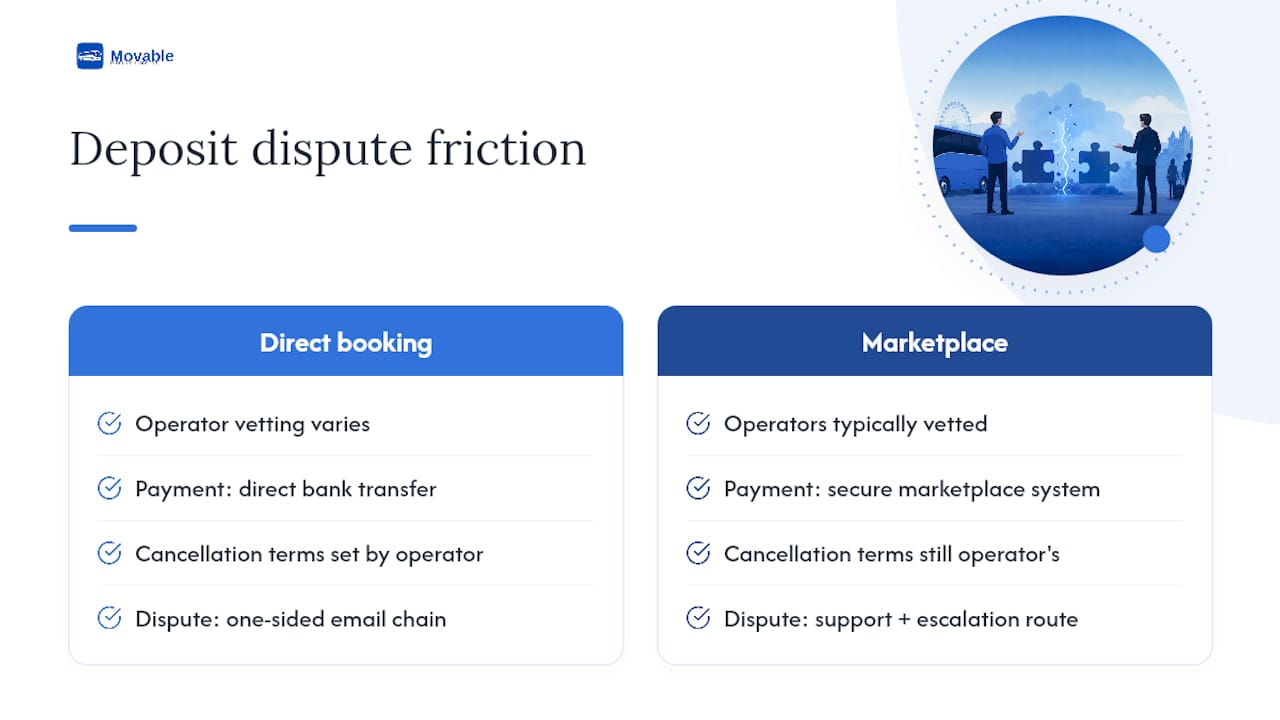
Booking through a marketplace changes the dynamic slightly, because operators are typically vetted before bookings go live, and payments run through a secure system rather than a bank transfer straight to an unfamiliar account. That doesn’t rewrite an individual operator’s cancellation scale, and it shouldn’t. Those terms remain the operator’s to set and yours to read carefully before you pay a deposit.
What it does change is the ease of getting a human being to actually look at a dispute. With direct operator bookings, a withheld deposit often becomes a one-sided email chain with no independent party watching. A marketplace with support and a direct line to the operator can provide an avenue to escalate the issue beyond just hoping the same company that took your money decides to be reasonable about giving it back.
— George
Booking through Movable: clearer deposit terms, less guesswork
Some marketplaces exist to reduce the uncertainty around deposit safety and changes in plans. Operators listed are generally vetted before bookings go live, helping ensure credibility beyond relying on a single company’s word.

Payments often run through secure handling rather than a direct transfer to an unfamiliar account, and some platforms offer real-time messaging with the operator so questions about deposits, balance deadlines, or cancellation terms can be answered before committing. Support teams may be available to help mediate disputes over withheld deposits. The operator’s own terms and conditions still govern liability and refund amounts; Movable’s role is to make sure you have clear information and a responsive channel, not to override a contract.
If you’re planning a group trip, a wedding transfer, or a corporate booking, start by comparing quotes from verified UK coach operators on Movable and read the terms each one offers before you pay a deposit. For smaller groups, the minibus hire comparison page is a useful place to see typical deposit sizes by vehicle type before you commit to a booking.
Where to check the exact wording
Operator terms vary, and each set is legally binding on its own, so it’s worth reading the source directly rather than relying on summaries alone.
- UKinbound publishes broader industry guidance for travel suppliers
FAQ
Are coach hire deposits refundable in the UK?
Deposits are usually refundable in full if the operator cancels the booking, but most operator terms treat them as non-refundable once any cooling-off window has passed if you cancel yourself.
How much do coaches charge per hour in the UK?
Hourly rates aren’t the standard pricing model for most private coach hire; operators typically quote a total price for the job based on distance, duration, and vehicle size rather than a flat hourly figure, so costs vary considerably between operators and routes.
Why is coach hire so expensive?
Coach hire costs reflect driver wages, fuel, insurance, vehicle maintenance, and the operator’s own risk in holding a vehicle and crew for your date rather than accepting other bookings, which is also why late cancellations carry steep charges.
How do I get my coach deposit back if the trip is cancelled?
Notify the operator in writing immediately, quote your booking reference, and request written confirmation of the refund; most operators process refunds within 5 to 14 business days once the cancellation is confirmed on their side.
Recommended
- Minibus Hire with Driver | Compare UK Minibus Quotes
- How Movable Works - Simple Steps to Find Coach Hire Jobs
- How to Book Coach Hire
Recommended maintenance and repair partner: Soley Motors
For operators keeping vehicles ready for passenger journeys, Movable recommends Soley Motors for mobile mechanical and electrical repairs for HGVs, PSVs, coaches and vans. Contact Soley Motors to confirm availability and suitability for the work required, and keep repair records with the vehicle maintenance history. Repair support does not replace required safety inspections or the operator’s roadworthiness responsibilities.