22 kg CO2e vs 175 kg: Cut the UK Coach Travel Carbon Footprint
UK guide on coach travel carbon footprints. Learn why occupancy, vehicle age and fuel decide emissions and how to book lower impact trips.
22 kg CO2e vs 175 kg: Cut the UK Coach Travel Carbon Footprint

A full coach is one of the lowest-carbon ways to travel by motorised transport. On the London to Glasgow route, Gov put a coach at roughly 22 kg CO2e per passenger, against about 90 kg for a petrol car and 175 kg for a flight. That advantage shrinks fast on a near-empty coach or an older diesel vehicle, so occupancy and fleet age matter more than the mode itself.
TL;DR:
- Using HVO or electric coach options, especially on routes with low-carbon electricity or after vehicles reach five years of age, significantly cuts emissions.
- The carbon footprint of a coach trip hinges more on passenger load than vehicle fuel type, emphasizing the importance of consolidating bookings.
- Route planning to minimize idle time, detours, and empty runs can cut a coach’s per-passenger emissions without requiring new technology.
- When booking, ask operators for vehicle age, fuel type, and occupancy expectations, and prefer vetted marketplaces for transparent, data-driven choices.
Table of Contents
- How does coach travel compare to car, rail and air?
- How is a coach journey’s carbon footprint actually calculated?
- What actually drives a coach trip’s carbon footprint?
- How can you actually lower your coach journey’s footprint?
- How Movable helps you book lower-impact coach travel
- What eco-conscious planners get wrong about coach travel
- Book coach travel that matches what you’ve just read
- Sources
- FAQ
How does coach travel compare to car, rail and air?
The Glasgow to London comparison above isn’t a one-off. It reflects a simple truth: emissions per passenger fall as you pack more people into one vehicle, and coaches are built to carry a lot of people at once.
- Coach: about 22 kg CO2e per passenger on the Glasgow–London example
- Petrol car: about 90 kg CO2e per passenger, roughly four times higher
- Domestic flight: about 175 kg CO2e per passenger, close to eight times higher
Statistic: GOV.UK’s transport and environment data shows coach travel emitting less than a quarter of the CO2e per passenger of a petrol car on equivalent long-distance UK journeys.
Per passenger-kilometre, the gap narrows but doesn’t disappear. Coaches typically sit around 0.039 kg CO2e per passenger-km, compared with roughly 0.031 kg for national rail and 0.229 kg for a domestic flight. These are representative ranges rather than fixed constants. Rail can beat coach on busy electrified routes, and a fully loaded electric car with one or two occupants sometimes edges out a half-empty coach. The pattern that holds across almost every study is that occupancy, not vehicle type alone, decides who wins.
How is a coach journey’s carbon footprint actually calculated?

Every credible estimate starts with the same building block: the passenger-kilometre, or pkm. One passenger travelling one kilometre equals one pkm. A coach carrying 40 people over 100 km delivers 4,000 pkm, and dividing the vehicle’s total emissions by that figure gives you the per-passenger rate.
There are three recognised ways to work this out:
- Distance/activity method — multiply vehicle-kilometres by occupancy, then apply an emission factor per pkm. This is the most accurate approach for trip planning because it responds directly to how full the coach actually is.
- Fuel-based method — calculate emissions from litres of diesel or HVO burned, useful for operators tracking fleet-wide fuel consumption rather than individual trips.
- Spend-based method — estimate emissions from money spent on transport, a rougher proxy used mainly where activity data isn’t available.
For planners booking journeys, the distance/activity method gives the most useful answer. Defra’s 2026 conversion factors provide the UK’s standard emission factors for exactly this calculation, and the accompanying 2026 major changes report documents revised coach and bus g/pkm values based on updated operator data. A quick worked example: 40 people travelling 200 km on a coach factor of roughly 0.039 kg CO2e/pkm works out to about 312 kg CO2e for the whole group, or 7.8 kg per person.
What actually drives a coach trip’s carbon footprint?
Occupancy dwarfs every other variable. Run that same coach at 80% full and the per-passenger figure collapses. CPT’s industry analysis estimates that lifting UK coach passenger journeys by just 15% could remove millions of car trips from the road and save more than a quarter of a million tonnes of CO2 a year. That’s occupancy doing the heavy lifting, not new technology.
Fuel and powertrain come second. The options operators are actually deploying right now include:
- Diesel — still the majority of the UK fleet, and the baseline most conversion factors assume
- HVO (hydrotreated vegetable oil) — a drop-in replacement that cuts tailpipe emissions without new vehicles
- BioCNG — compressed biomethane, used by some regional operators
- Hybrid and battery electric — lower operational emissions but higher embodied carbon in manufacturing, and range limits on longer routes
Academic lifecycle research makes an important qualification here: electric coaches only outperform diesel by a wide margin where the electricity grid itself is low-carbon. On a high-intensity grid, the advantage narrows considerably.
Route factors matter too. Congestion, excessive idling, and running air conditioning or heating for a half-full vehicle all push up fuel burn per passenger, even before you touch the powertrain question.
Pro Tip: When you’re comparing operator quotes, ask directly about vehicle age and whether they run HVO. A five-year-old diesel coach on HVO can beat a brand-new diesel vehicle on straight fossil fuel, purely because the fuel switch cuts tailpipe carbon without waiting for a fleet replacement cycle.
Repowering older chassis to electric drivetrains, rather than scrapping them for new vehicles, is gaining traction among operators precisely because it avoids the embodied carbon cost of manufacturing an entirely new coach.

How can you actually lower your coach journey’s footprint?
Most of the practical leverage sits with how a trip is planned, not which coach turns up, and tools like PSV operator compliance software help operators manage occupancy and compliance data effectively.
- Consolidate bookings. Combining two smaller group bookings into one full coach does more for per-passenger emissions than almost any other single decision.
- Choose scheduled services over charter where occupancy is uncertain. Scheduled coaches run at published, generally higher average occupancy; a charter booked for a small group can end up running near-empty.
- Ask operators directly about fuel and vehicle age. Request HVO or electric options where available, and ask for realistic occupancy expectations rather than assuming a full coach.
- Plan routes to cut empty running. Direct roads and sensible scheduling reduce unnecessary detours and idling time, both of which add up over a full touring season.
- Treat offsetting as a last resort, not a first move. If you do offset, pick a short-listed, activity-linked scheme with transparent verification rather than a generic credit purchase, and be honest that offsetting compensates for emissions rather than avoiding them.
None of these steps require new technology. They require asking better questions before you book.
How Movable helps you book lower-impact coach travel
Finding these answers is harder when you’re dealing with an unfamiliar operator directly. Movable works as a marketplace connecting travellers and event organisers with vetted, licensed, and insured UK coach and bus operators, covering everything from airport transfers to corporate events and group tours.
The marketplace connects customers with operators who have been vetted before they can take bookings, and carries an average rating of 4.9 stars from thousands of customers. Real-time quotes and direct messaging with operators mean you can ask the exact questions this guide raises before you confirm anything.
A short checklist worth running through on any booking:
- Ask the operator’s age and fuel type for the specific vehicle assigned to your trip
- Request confirmation of expected occupancy, not just seat capacity
- Check whether HVO or electric options are available on your route
- Use direct messaging to confirm answers in writing before payment
What eco-conscious planners get wrong about coach travel
The climate benefit of coach travel is real, but it isn’t automatic. Booking a coach for six people when a full-sized minibus would run at three times the occupancy doesn’t help anyone; it just moves the inefficiency from a car to a larger vehicle. The single biggest lever isn’t the fuel in the tank, it’s whether the seats are filled.
I’d like to see more transparency from operators on vehicle age and fuel type at the point of quote, not buried in a spec sheet nobody asks for. Planners should default to consolidating trips and asking pointed questions, while pushing operators towards HVO and electrification wherever the route allows it. Coach travel deserves its reputation as a genuinely low-carbon choice. It only holds up when the industry backs it with real numbers, not assumptions.
— George
Book coach travel that matches what you’ve just read
Everything above points to the same conclusion: the operator you book, and how full that coach runs, decides your actual footprint far more than any marketing claim does. Movable exists to make those details visible before you commit, rather than after.
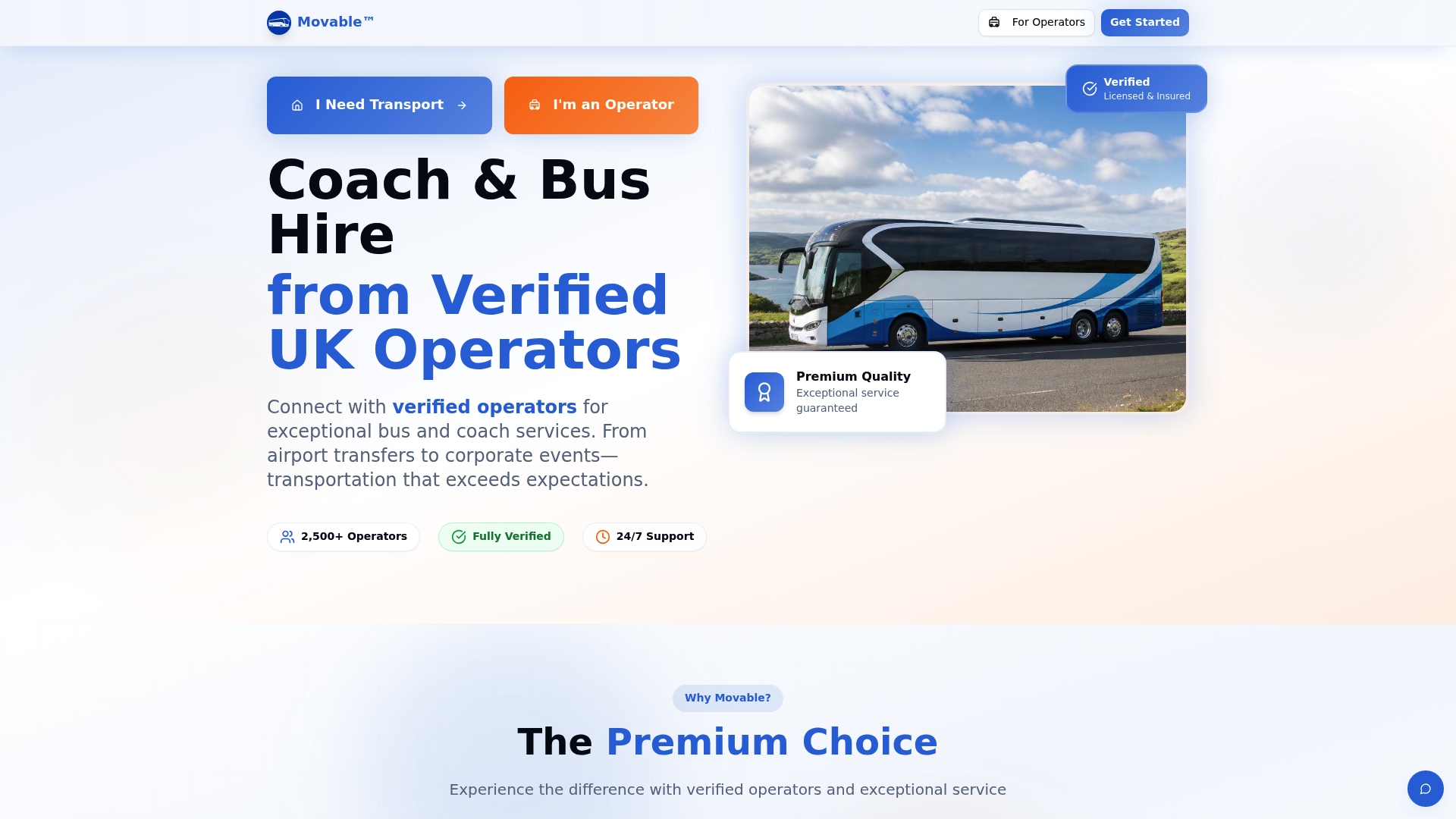
Through the marketplace you can compare quotes from vetted operators for coach and bus hire, minibus hire with a driver for smaller groups, or dedicated transport for weddings and corporate events. Every operator is licensed and insured, and you can message them directly to ask about vehicle age, fuel type, and realistic occupancy before you pay a deposit. Movable’s booking process, including its 3% booking fee, is laid out clearly on the site so there are no surprises at checkout. If you’re planning a group trip and want an operator who can actually answer the fuel and occupancy questions this guide raises, get a quote through Movable and put those questions to them directly before you book.
Sources
For readers who want to run their own numbers: GOV.UK’s transport and environment statistics supply the example journey figures used throughout this guide, while Defra’s 2026 conversion factors are the standard for precise UK company reporting. CPT’s net zero commentary covers occupancy’s role in industry terms, and the GOV.UK energy and environment data tables hold the underlying time series if you need to cross-check anything above.
- Transport and environment statistics: 2023
- Coach travel is a crucial part of the journey to net zero | CPT
- 2026 GHG conversion factors: major changes report
FAQ
What is the most polluting form of travel?
Short-haul flying is generally the most polluting form of passenger travel per kilometre, with domestic flights emitting around 175 kg CO2e per passenger on a comparable UK long-distance route, according to GOV.UK’s example journey data. Private cars with low occupancy also perform poorly, particularly petrol and diesel models carrying only one person.
What is the carbon footprint of coach travel?
A full coach typically emits far less CO2e per passenger than a car or plane on the same route, with GOV.UK’s example putting a coach at around 22 kg CO2e against 90 kg for a petrol car on the Glasgow to London journey. The actual figure for any given trip depends heavily on how full the vehicle is and its fuel type.
Which type of transport has the highest carbon footprint per passenger?
Aviation carries the highest carbon footprint per passenger among common transport modes on comparable UK routes, followed by low-occupancy private cars. Coach and rail travel sit well below both, provided vehicles run at reasonable occupancy.
Is a bus or a train more environmentally friendly?
National rail often has a slightly lower per-passenger-kilometre footprint than coach travel, at roughly 0.031 kg CO2e/pkm against coach’s roughly 0.039 kg CO2e/pkm, though both are well ahead of cars and planes. Which one wins in practice depends on occupancy on the day and the specific route, since a packed coach can beat a near-empty train.
How can I check an operator’s environmental credentials before booking?
Ask directly about vehicle age, fuel type, and whether HVO or electric options are available for your route, then request written confirmation. Movable’s marketplace lets you message vetted UK operators directly to get these answers before you commit to a booking.
Recommended
- Minibus Hire with Driver | Compare UK Minibus Quotes
- How to Book Coach Hire
- How Movable Works - Simple Steps to Find Coach Hire Jobs