20 kg coach luggage allowance in the UK — what operators allow
UK coach luggage: most operators allow one large case or two medium items (about 20 kg) plus a small hand bag. Measure, label, and buy extras online.
20 kg coach luggage allowance in the UK — what operators allow
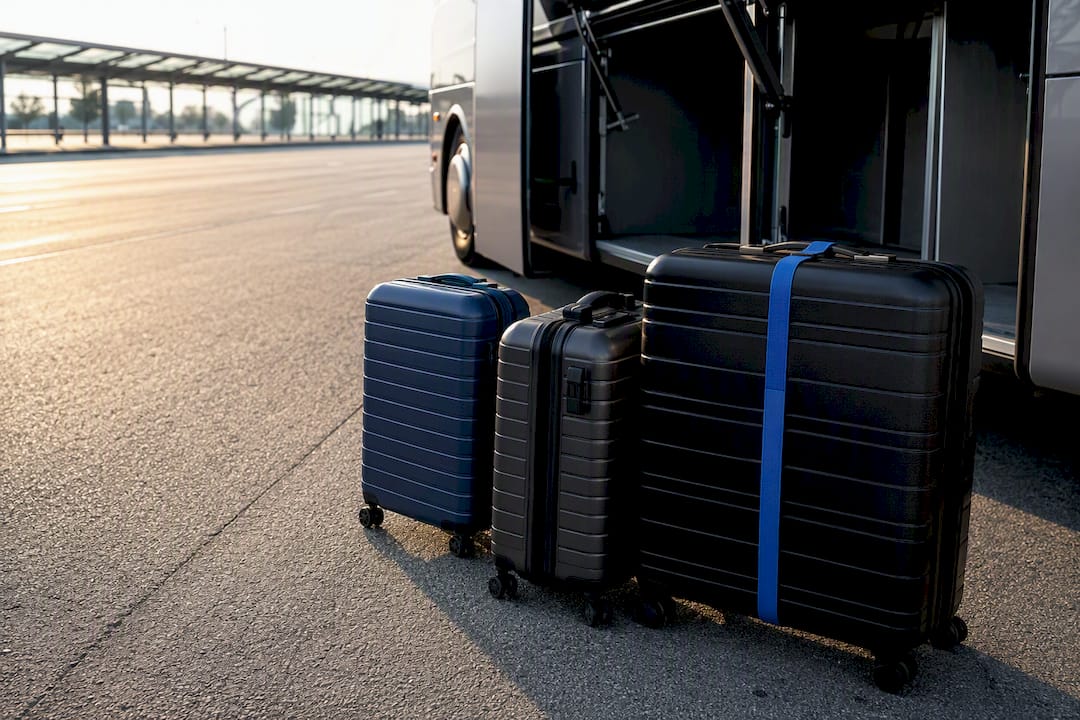
Most UK coach operators let you bring one large suitcase (roughly 75 × 50 × 32 cm) or two medium bags (around 70 × 45 × 30 cm) in the hold, capped near 20 kg, plus one small soft hand bag around 45 × 35 × 20 cm. Weigh your bags at home, check your operator’s exact policy before you travel, and buy any extra luggage online rather than turning up on the day.
TL;DR:
- Most UK coach operators allow one large suitcase or two medium bags in hold, with a weight limit around 20 kg per ticket, and separate allowances for hand luggage.
- Packing smart involves measuring each bag’s dimensions, weighing everything beforehand, and splitting heavy items across multiple bags to avoid overweight charges.
- Special items like bikes, skis, and wheelchairs require advance declaration and may not follow standard luggage rules, so contacting the operator prior to travel is essential.
- Buying extra luggage allowance online before departure is more cost-effective and reliable than paying higher on-the-day fees, which are capped and subject to availability.
- Group travel requires careful coordination of individual allowances, and booking extras in advance reduces last-minute stress and potential shortages at loading.
Table of Contents
- Typical coach luggage allowances across UK operators
- How to measure, pack and label your luggage correctly
- Special items: pushchairs, wheelchairs, sports kit and bikes
- Excess luggage: buying extra allowance and what it costs
- Journey-specific checks: airport transfers, coach hire and long trips
- How luggage allowance shapes group and family bookings
- Movable’s take: cutting out luggage guesswork before you travel
- Sources
Typical coach luggage allowances across UK operators
The rules vary slightly by operator, but the pattern is consistent enough that you can pack with confidence before checking a single policy page. Most companies build their allowance around one large case or two medium ones, never both at once.
National Express allows one large suitcase (approximately 75 × 50 × 32 cm) or two medium suitcases (roughly 70 × 45 × 30 cm) in the hold, with a 20 kg weight ceiling applying per ticket. Megabus mirrors this almost exactly: one large case or two medium items, with a combined weight limit typically around 20 kg. That overlap isn’t a coincidence. Coach holds have fixed physical space, and operators size their allowances to what actually fits underneath a standard vehicle without slowing down loading at every stop.
Hand luggage sits in a separate category. Operators typically permit one soft item, around 45 × 35 × 20 cm, that goes under your seat or in the overhead rack. Some set an informal weight suggestion for this bag, though it’s rarely weighed the way hold luggage is.
A few details catch travellers out:
- The allowance is per ticket, not per group, so a family of four gets four separate allowances, not one shared pool.
- Some operators calculate limits by combined linear dimensions (length plus width plus height) rather than a single box measurement, so a bag that’s technically “medium” on one side could fail on another.
- Hard-shell suitcases and rigid cases are usually fine for the hold but rarely count as hand luggage, since “soft” often means flexible enough to squash under a seat.
- International or specialised routes can run different numbers entirely. Lux Express, for example, allows up to 23 kg in the hold, a few kilograms above the typical UK figure.
That last point matters more than it sounds. If you’re booking a cross-border service or a niche route, don’t assume the domestic 20 kg rule applies. Check the operator’s own FAQ, such as the National Express FAQ page, before you pack.
How to measure, pack and label your luggage correctly
Getting your bag through without a fuss comes down to measuring properly and packing smart, not luck.
- Measure length, width and height separately, then add them together if your operator quotes a combined linear dimension rather than a single box size.
- Check whether your hand luggage genuinely counts as “soft” — a rigid briefcase or hard-shell vanity case often needs to go in the hold instead, even if it’s small.
- Weigh everything at home using a luggage scale before you leave, especially if you’re close to the 20 kg mark.
- Split heavy items across two medium bags rather than overloading one large case, since most operators allow either option and two bags under the limit beats one bag over it.
- Label every hold bag with your name and destination, and keep passports, medication and valuables in your hand luggage, never in the hold.
- Stow hand luggage under your seat or in the overhead rack, keeping the aisle and footwells clear for other passengers and the driver’s sightlines.
Pro Tip: If your case is borderline on weight, move your heaviest single item (books, boots, a laptop) into your hand luggage rather than checking a second bag. It’s usually the fastest way to dodge an overweight charge without buying anything extra.
Special items: pushchairs, wheelchairs, sports kit and bikes
Mobility equipment gets more lenient treatment than ordinary luggage. Fully collapsible wheelchairs and folding pushchairs are typically carried free of charge and don’t count towards your hold allowance on most services, though operators generally ask that they’re folded down and boxed where practical.
Sports equipment is treated far more strictly:
- Skis, snowboards and similar kit usually count as a full luggage allowance item in their own right, meaning they may replace your suitcase allowance rather than sit alongside it.
- Bicycles almost always need proper packaging (a bike bag or box) and should be declared when you book, not mentioned at the departure gate.
- Golf bags, surfboards and other oversized sports gear fall into the same “declare in advance” category.
- Smaller vehicles have noticeably less hold space than full-size coaches, so an item that fits easily on one service might not fit on a minibus running the same route.
If you’re travelling with a mobility aid that isn’t fully collapsible, or with any bulky sports equipment, contact the operator directly before travel to confirm how it will be stored and handled. Assuming it’ll “probably be fine” is the single most common mistake travellers make with special items, and it’s the one most easily avoided with a two-minute message.
Excess luggage: buying extra allowance and what it costs
If your packing list won’t fit inside the standard allowance, buying extra space in advance is almost always the better move. National Express charges around £10 for an additional item on a single journey and £20 on a return, with on-the-day prices running noticeably higher than the online rate. Megabus follows the same logic, selling additional luggage slots at booking for a small fee rather than pricing them as a last-minute add-on.
A few practical points worth knowing before you book:
- Operators commonly cap how many extra items you can buy, often limiting the chargeable hold items per passenger, and once that cap is reached, no amount of extra payment will secure more space.
- Passengers with a booked allowance are prioritised over anyone trying to add luggage on the day, so late requests are genuinely “subject to space” rather than a formality.
- You can usually add extras during the online booking flow, by calling the operator’s contact centre, or at some staffed coach stations, though options shrink the closer you get to departure.
- Turning up with unbooked excess luggage risks a higher on-the-day charge, and if the hold is already full, the driver can refuse it outright.
The pattern here isn’t really about price, it’s about certainty. Paying an online fee buys you a guaranteed slot; paying more on the day risks uncertainty. General guidance on how carrier surcharges work across the travel industry backs this up: last-minute add-ons are consistently priced to discourage last-minute decisions, not just to raise revenue.
Journey-specific checks: airport transfers, coach hire and long trips
Different journey types bring different luggage headaches, and it pays to think about yours specifically rather than relying on general rules.
- Airport transfers mean juggling two sets of rules at once, the airline’s and the coach’s, so pack for the stricter of the two and confirm whether the vehicle can handle oversized trolley cases if you’re returning from a long-haul trip. Practical advice on airport coach transfers is worth a read if you’re coordinating a group arrival with mixed luggage needs.
- Coach and minibus hire for private groups needs a direct conversation with the operator, since hold capacity varies significantly by vehicle size, and a minibus rarely matches a full-size coach’s storage.
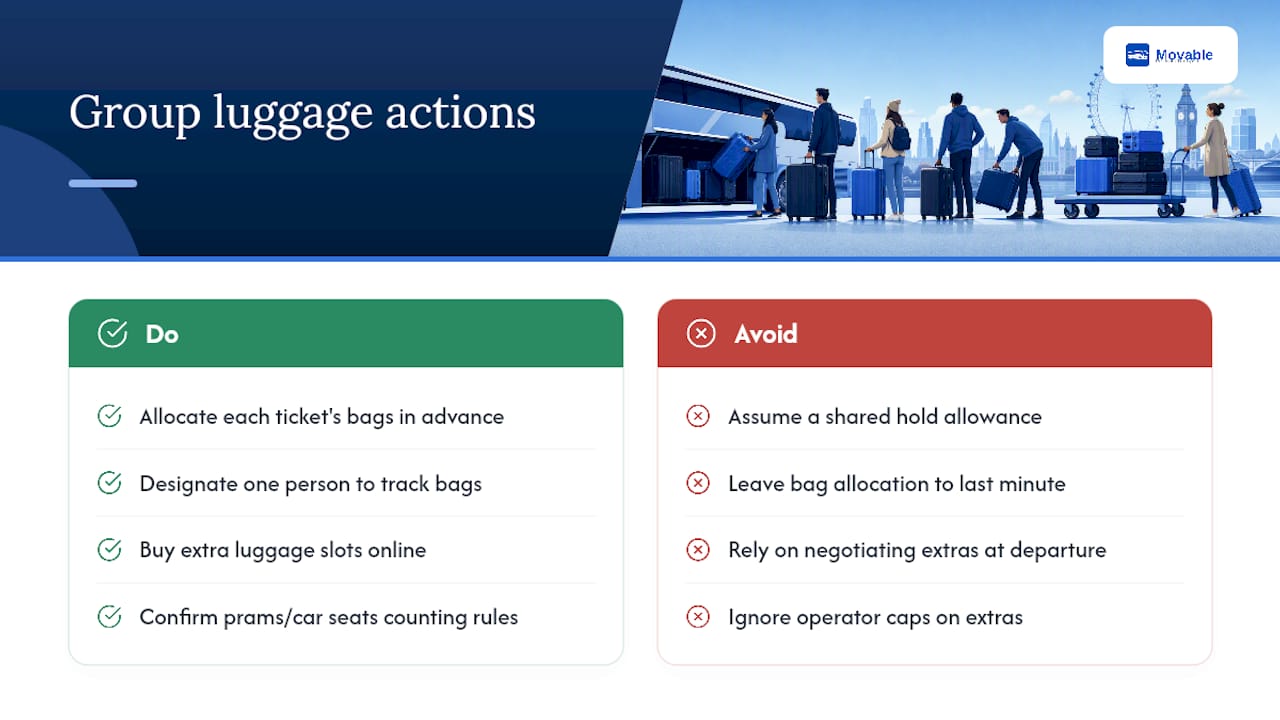
- Group bookings work best when someone allocates luggage across individual tickets in advance, or buys extras as a batch, rather than leaving it to chance on the day.
- Before departure, confirm: hold weight limit, hand luggage size, whether extras are still purchasable, and whether any special items have been declared.
How luggage allowance shapes group and family bookings
Group and family travel is where the “per ticket” rule causes the most confusion, and the most missed savings. A family of five doesn’t get one shared 100 kg hold budget. Each ticket carries its own individual allowance, which means the family member travelling lightest effectively “wastes” unused capacity that a heavier-packed sibling could have used, if only the tickets had been coordinated in advance.
For school trips, wedding parties and tour groups, this adds up fast. Twenty passengers each entitled to one large case gives an organiser real flexibility, but only if bags are allocated deliberately rather than left to whoever grabs which case at the last minute. It’s worth designating one person to track who’s carrying what, particularly when a handful of travellers need extra allowance for instruments, sports kit or additional cases.
Booking extras also works differently at group scale. Buying five additional luggage slots at the online rate, rather than hoping five people can each negotiate on the day, is both cheaper and far more reliable, especially since operators cap the total number of chargeable extras per service. For family trips involving children, prams or car seats, it’s worth confirming separately whether these items count against the group’s luggage total or sit outside it entirely, since practice varies between operators and even between routes run by the same company.
The organisers who avoid last-minute stress are the ones who treat luggage as a booking-stage decision, not a departure-day negotiation.
Movable’s take: cutting out luggage guesswork before you travel
Most luggage problems on coach journeys come down to one thing: nobody asked the operator directly before booking. Every company we’ve discussed here publishes sensible rules, but “sensible” still leaves room for a bike, a wheelchair, or a fifth suitcase to fall into a grey area.
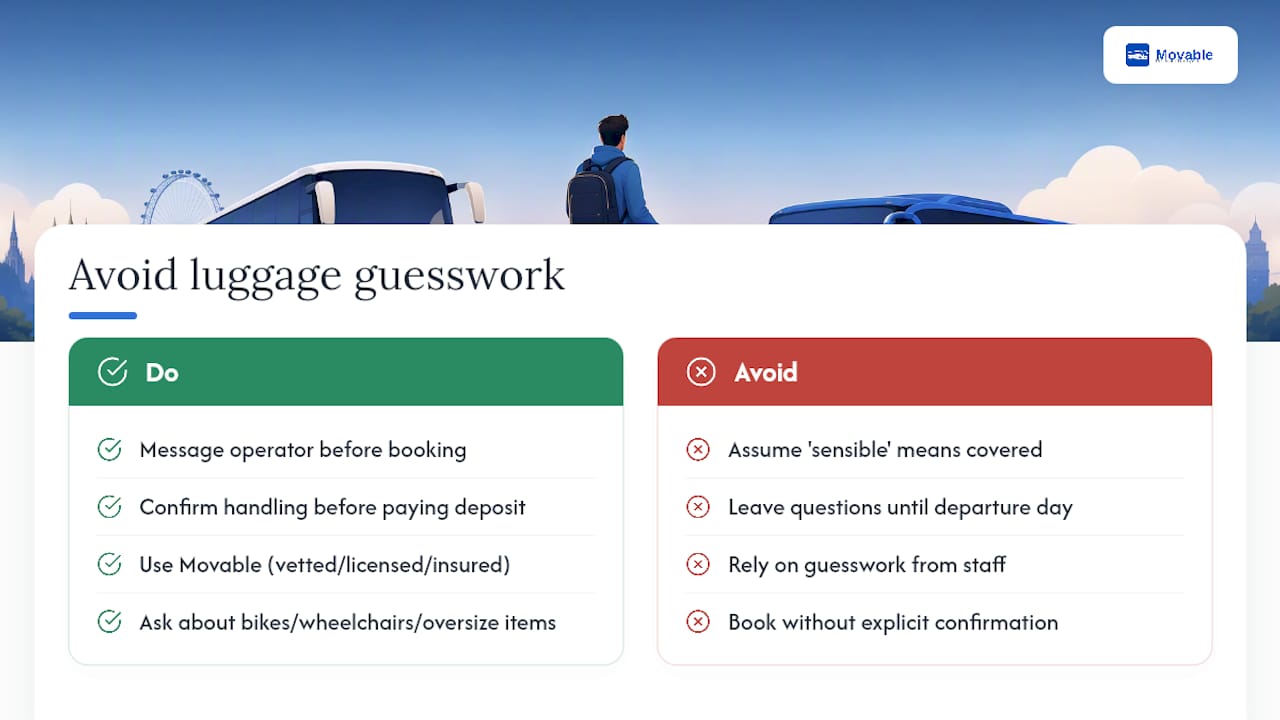
That’s the gap Movable is built to close. Every operator on the platform is vetted, licensed and insured, and you can message them directly to confirm exactly how your luggage, mobility equipment or oversized items will be handled before you pay a deposit. The platform is designed so unusual booking questions get real answers, not guesswork.
If your trip involves anything outside the standard one-case-plus-hand-bag pattern, whether that’s a group tour, a minibus hire, or an airport transfer with awkward luggage, message the operator through Movable before you travel. It takes minutes and settles the question properly, rather than leaving it to a loading bay argument on departure day.
— George