4.5 hour break: decide which UK coach driver hours rules apply
UK coach driver hours explained: the 4.5 hour break, weekly rest and how to decide which rule set applies. Includes what records to keep and a short...
4.5 hour break: decide which UK coach driver hours rules apply

A coach driver’s hours are governed by two possible regimes. Under assimilated rules, daily driving is capped at a set limit of hours, with a maximum extension allowed a few times per week; weekly and two-week driving time limits are also established, alongside a mandatory break period after a specified continuous driving duration. Under GB domestic rules, daily driving can reach a defined maximum duration within a specified working day length, with a required rest period between shifts that may be reduced a limited number of times per week. Which set applies depends on the vehicle and the route, and getting that decision right comes first.
TL;DR:
- Drivers working under assimilated rules must adhere to daily, weekly, and biweekly driving limits, with a 4.5-hour maximum driving period before a 45-minute break.
- The most common violation occurs when drivers skip or rush their 45-minute break, often due to pushing to complete a route segment.
- Correctly determining which rules apply requires checking vehicle capacity, route type, and crossing borders, as unfamiliarity leads to scheduling mistakes.
- Breaks cannot include loading, cleaning, or paperwork, and supervising passengers or luggage does not count as rest time, risking non-compliance.
- Employers must manage working hours, record keeping, and scheduling to prevent fatigue-related risks, with tachograph records retained for at least a year.
Table of Contents
- Coach driver hours: the quick reference numbers
- Working out which rules apply to your journey
- Breaks and daily rest: what actually counts
- Working time, spreadover and what employers must manage
- Tachographs and records: what to keep on board
- A practical compliance checklist for coach driver hours
- Why compliant scheduling actually matters
- Sources
Coach driver hours: the quick reference numbers
Before anything else, the figures. These are the numbers that get checked on the roadside, at depots, and during traffic commissioner reviews, so they’re worth knowing cold rather than looking up mid-shift.
Under assimilated rules, which apply to most cross-Channel and larger commercial coach work, daily driving duration is capped with limited extensions allowed, weekly and biweekly driving limits are in place, and drivers must take regular breaks after specified continuous driving periods.
Under GB domestic rules, which cover many purely UK-based passenger services, there is a maximum daily driving duration within a total working day length limit, and mandated rest periods between working days that can be reduced under certain conditions.
Pro Tip: The 4.5-hour break threshold is the single most breached rule in roadside checks, largely because drivers push on to “just finish the leg” rather than stopping. A missed break here is an easy, avoidable violation.
Working out which rules apply to your journey
This is where most scheduling mistakes happen, and it’s rarely deliberate. A driver or operator picks the wrong regime, not because they’re careless, but because the test isn’t always obvious from the booking sheet alone.
The key factors:
- Vehicle and passenger capacity. Larger passenger vehicles used commercially generally fall under assimilated rules by default.
- Route type. A short national regular service under 50 kilometres can sit outside the full assimilated regime; an international occasional service almost always sits inside it.
- Cross-border legs. Even a brief stretch of driving abroad can pull the entire day under assimilated or AETR provisions, not just the foreign portion.
A simple pre-trip checklist helps: confirm the vehicle’s classification, check whether any leg crosses a border, note the total booked distance, and record which rule set applies before the driver sets off. That last step matters more than it sounds. Regulators expect operators to be able to show why a particular regime was chosen for a given service, not just that a decision was made.
Breaks and daily rest: what actually counts
Breaks aren’t just a box to tick. They have to be genuine rest, and the rules are specific about how they can be structured.

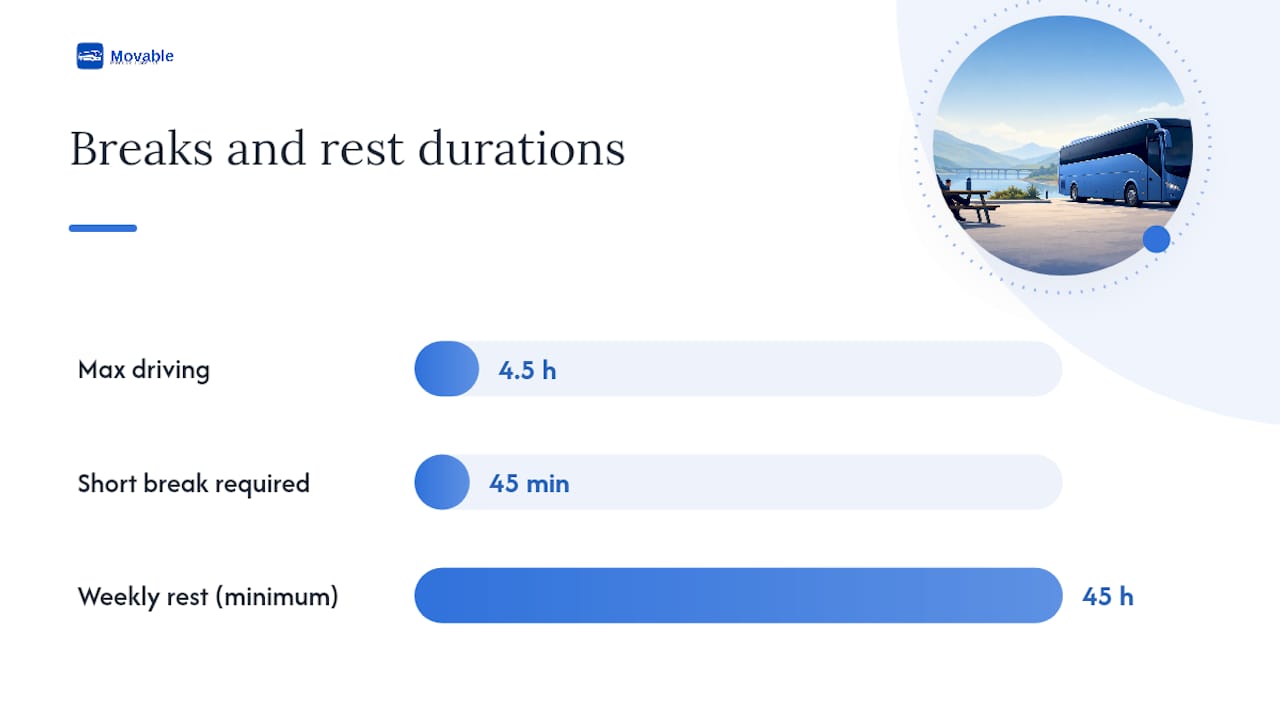
Under assimilated/AETR rules, a driver needs 45 minutes of break after at most 4.5 hours of driving. That break can be split into two: 15 minutes first, then 30 minutes, but not the other way round. Weekly rest of at least 45 hours (or a reduced version, subject to compensation) sits alongside this, giving drivers proper recovery time between longer duty periods.
Under GB domestic rules, break triggers can occur at the 5.5-hour mark in certain spread-over scenarios, with a 30-minute minimum break applying. Daily rest between working days is normally set at a certain minimum duration but may be reduced a limited number of times per week, with compensatory rest advised to avoid habitual shortfall.
Common, lawful examples include a driver splitting a break around a passenger pickup, or taking the full 45 minutes at a motorway services stop midway through a long transfer. Mistakes to avoid:
- Treating loading, cleaning, or paperwork time as part of the break
- Taking the required break right before the shift ends, when it offers no real recovery benefit
- Stacking multiple reduced daily rests back to back without compensating later
Pro Tip: A break spent supervising passengers or handling luggage doesn’t count as rest under the rules. If a driver is still “on duty” in any sense, the clock hasn’t stopped.
Working time, spreadover and what employers must manage
Spreadover and driving time are not the same thing, and conflating them is a common scheduling error. The 16-hour spreadover cap under GB domestic rules covers the whole working day, including loading, waiting, and administrative duties, but it never extends the underlying 10-hour driving limit itself.
Layered on top of drivers’ hours rules are separate working-time obligations: an average 48-hour working week over the reference period (with an opt-out available in some cases), and a hard ceiling of 60 hours in any single week provided the average stays compliant.
Employers carry real responsibility here, not just the driver:
- Build rosters that keep both drivers’ hours and working-time limits compliant simultaneously
- Account for individual circumstances, such as a driver returning from reduced rest
- Keep documented evidence of compliance decisions, not just the outcome
Tachographs and records: what to keep on board
Assimilated rules require a tachograph, whether digital or analogue, recording driving, other work, availability, and rest. Drivers must be able to produce their driver card, any manual entries, and printouts covering the current day plus the previous 28 days on request.
For GB domestic work, digital tachographs are still commonly used even where a full record book would technically suffice, since they simplify audits considerably. A short daily checklist keeps drivers covered:
- Driver card inserted and functioning correctly
- Manual entries completed for any non-driving periods
- Printouts or backup records available for the last 28 days
- Previous week’s records retained in case of a roadside check
Records generally need retaining for at least a year, longer if an operator’s own policy or insurer requires it.
A practical compliance checklist for coach driver hours
Getting this right day to day comes down to habits, not memory. Before the trip, in the shift, and afterwards, there’s a short list worth running through every time.
- Before departure: Confirm which rule set applies, check the tachograph is fitted and working, and map out planned breaks and rest stops against the booked route.
- During the shift: Track running totals for driving and duty time, take breaks in full and uninterrupted, and log any emergency deviation (such as unexpected traffic delays) with a clear written note.
- After the shift: File tachograph and manual records promptly, schedule compensatory rest if a reduction was used, and flag any pattern of repeated reduced rests to the rostering team before it becomes routine.
Pro Tip: If a reduced daily rest gets used on a Tuesday, build the compensating rest into the schedule before the following weekend, not whenever there happens to be a gap. Leaving it open-ended is how compliance quietly slips.
Why compliant scheduling actually matters
Movable works with vetted, licensed, and insured operators precisely because drivers’ hours rules exist for a reason beyond paperwork: fatigue causes crashes, and the traffic commissioners have said as much directly. One habit worth adopting: whenever a driver takes a reduced rest, pencil in the compensatory rest immediately rather than hoping the roster sorts itself out later. For anything unusual, cross-border legs or multi-day tours, the official GOV.UK guidance is worth reading in full before you commit to a schedule.
— George
Sources
For the full legal detail behind these limits, the primary references are GOV.UK’s assimilated rules guidance, GOV.UK’s GB domestic rules page, the Road Transport (Working Time) Regulations 2005, and Regulation (EC) No 561/2006 for the EU legal basis underpinning assimilated limits. These pages are updated periodically, so check them directly before finalising any unusual or international schedule. If you’re booking transport and want the compliance side handled by someone else, Movable connects you with vetted UK coach and bus operators who already build these rules into their scheduling.